
REVIEW · PRIVATE TUK TUK TOURS
Porto Half Day Private Tuk Tuk Tour
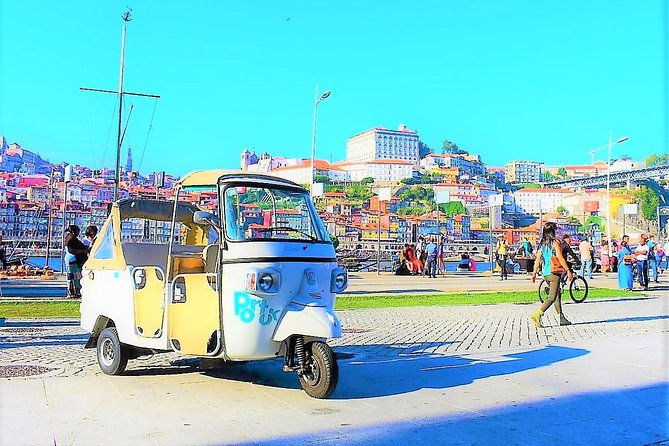
A tuk tuk is a smart way to get your bearings in Porto, a city built on steep hills, tight lanes, and sudden viewpoints. In about three and a half hours, you can cross into Gaia, see the Dom Luís I Bridge from above, pause at Serra do Pilar, and sweep through the old center without wearing out your legs. I especially like the private format and the chance to adjust the route. Guides such as Ana, Fabio, Rafaela, Gabi, and Bernardo have been praised for local tips, easy conversation, and thoughtful pacing.
I also like the mix of major sights and city character: grand churches, tiled façades, old markets, gardens, and backstreets all appear in one ride. The main caution is consistency. Some tours have been shortened, shared with another couple despite being sold as private, or delivered with limited commentary. The tuk tuk canopy can also make it hard to see or hear, especially in rain or traffic.
Key points to know before booking
- A fast introduction to two cities: The route covers Porto and Vila Nova de Gaia, including river views and the Dom Luís I Bridge.
- Private in principle: Your group should have its own tuk tuk, with capacity for two, three, or four adults of average height and up to 75 kilograms each.
- Flexible sightseeing: Guides can adjust stops around your interests, such as gardens, churches, viewpoints, neighborhoods, or food suggestions.
- Wine tasting included: A short tasting is part of the experience, though one disappointing tour did not provide it.
- Good for hills and limited time: The vehicle cuts down on uphill walking and reaches narrow streets that larger vehicles cannot.
- Check the vehicle and timing: Covered sides can obstruct views, and a small number of tours have involved late arrival, weak communication, or an unexpectedly short ride.
Why a tuk tuk works well in hilly Porto
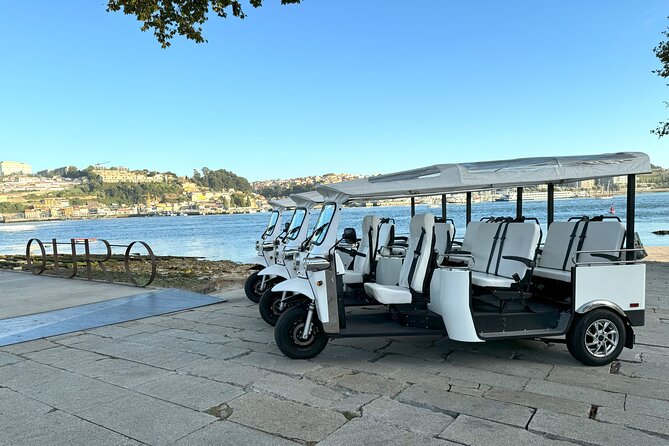
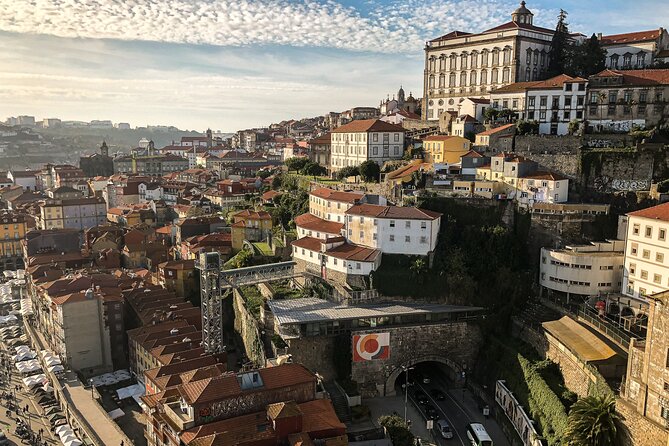
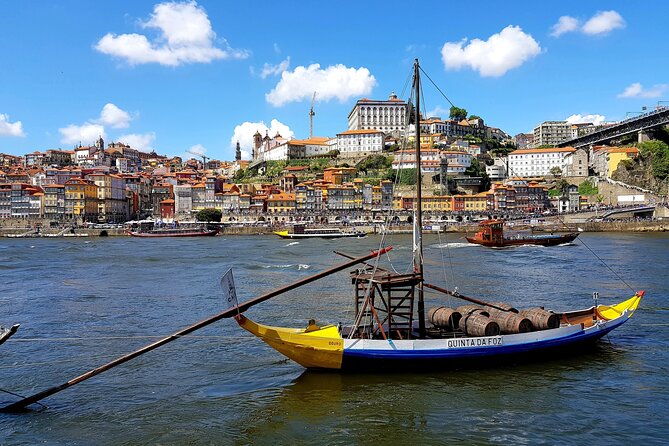
Porto is compact on a map but demanding on foot. The historic center rises and falls sharply, and the Douro separates Porto from Gaia, where many port lodges and grand river views are found. A tuk tuk lets you cover both sides without turning your first day into a workout.
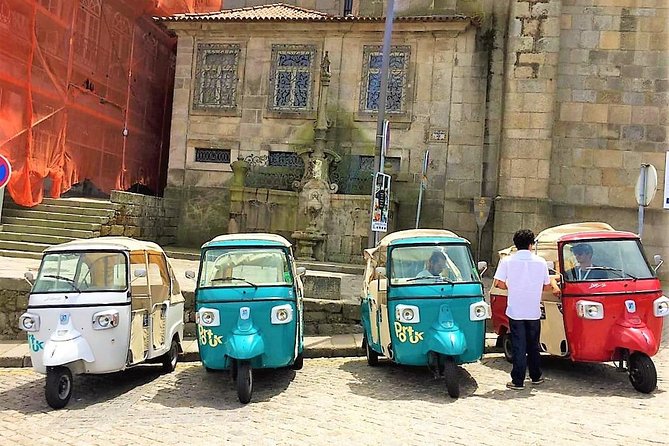
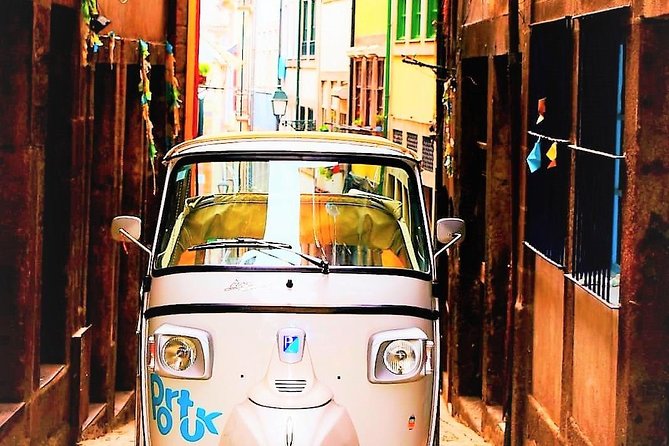
You sit close to the street, which gives the ride a more personal feel than a large bus. The driver can use narrow lanes and make quick photo stops. Guides have also taken passengers through smaller streets and different neighborhoods, giving you a look beyond the usual postcard points.
The tradeoff is comfort and visibility. This is not a silent, glass-sided sightseeing vehicle. Traffic noise can make commentary hard to follow, and the plastic windows or canopy may be cloudy or obstruct your view. On a dry day, that may be a minor nuisance. On a wet day, it can change the whole experience.
The tour is sold as private, so your own group should ride together. Each vehicle holds two to four adults of average size. Larger parties use several tuk tuks and travel together, stopping at the same places. Confirm the private arrangement at the start, since a few bookings were combined with another couple because of overbooking.
More Private Tuk Tuk Tours in Porto
- Discover Porto’s Highlights on a 2-Hour Private Electric Tuk Tuk
★ 4.5 · 1,860 reviews - Historic Porto by Private Electric Tuk Tuk to Top Landmarks
★ 4.5 · 735 reviews - Porto: Private Sightseeing Tour by Electric Tuk Tuk
★ 4.8 · 305 reviews
Serra do Pilar gives you the best opening view
The first major stop is Serra do Pilar, the circular monastery above Gaia. It began in 1538 and took more than a century to finish. The monastery later became a military position during the Liberal Wars, and its round church and circular cloister give it an unusual shape.
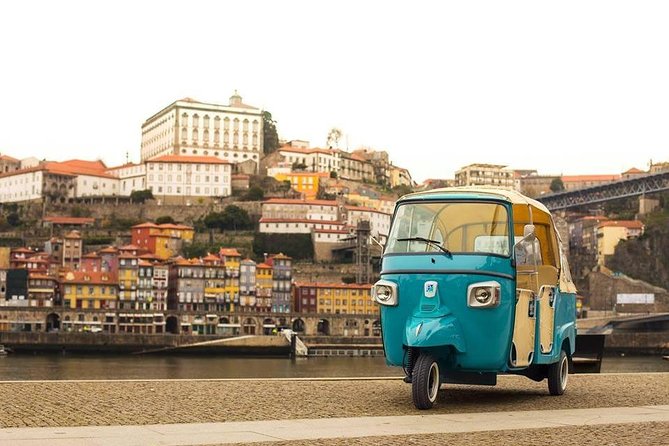
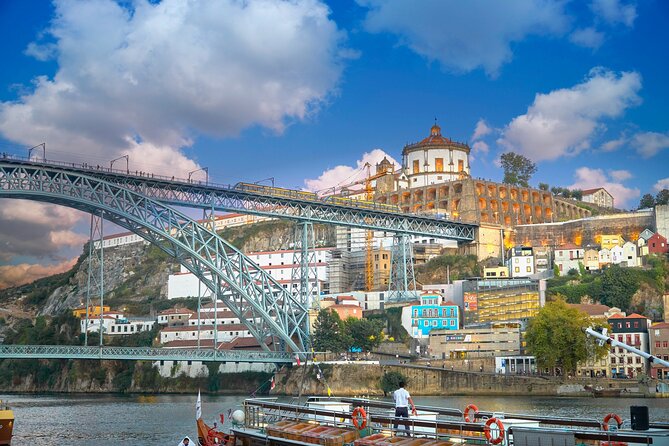
You get about 15 minutes here, with admission listed as free. The real prize is the terrace. From this high point, you can look across Porto’s historic center, the cathedral, the Dom Luís I Bridge, Gaia, the riverfront, the Arrábida Bridge, and the Fontainhas area.
This is one of the tour’s most useful stops because it makes Porto’s layout clear. You can see how the city climbs from the river and how the bridge links two distinct urban areas. If the weather is clear, this may be the best place to take your broad city photographs.
The short stop also means you should not expect a full monastery visit. The emphasis is on the view and the guide’s explanation, not a long interior tour.
The Dom Luís I Bridge connects Porto and Gaia
The Dom Luís I Bridge is one of Porto’s defining sights. Designed by Teófilo Seyrig, a colleague and student of Eiffel, it opened in 1886 with two iron decks. Its great arch spans 395 meters, and the upper deck now carries Porto’s metro between the cathedral area and Gaia.
Crossing the bridge by tuk tuk gives you a quick sense of the city’s two-level geography. You may see the river below, the old buildings rising on the Porto side, and the open views toward Gaia. The crossing is brief, but it helps connect the viewpoints into one story.
Traffic, construction, and police restrictions can affect the route. One guide handled a traffic accident well by changing the order of stops, while another tour lost time in bottlenecks. This is a moving city tour, not a fixed rail journey, so the exact sequence can change.
Churches and the gold-covered interior
The itinerary brings you past several churches, but not every visit is an extended interior tour. São Francisco is the city’s major Gothic church, begun in the fourteenth century and transformed inside during the seventeenth and eighteenth centuries. Its carved, gilded woodwork is so abundant that it earned the nickname Church of Gold.
The Tree of Jesse and the catacombs are especially notable. It is a National Monument and part of Porto’s UNESCO-listed historic center. Admission is not stated as included for this tour, so treat this as a possible exterior stop unless your guide confirms time and entry.
The nearby Igreja dos Carmelitas is a seventeenth-century church with a classical façade and a Porto rococo altarpiece. Its side wall, covered in blue and white tiles in 1912, is one of the city’s most photographed church façades. The stop is about five minutes and admission is listed as free.
Next door, Igreja do Carmo dates from the eighteenth century. Its side tiles show scenes connected with the worship of Our Lady, while the interior carvings reflect Porto rococo. Like the Carmelitas stop, this is a quick look rather than a full guided church visit, and admission is not included.
At São Bento da Vitória, you pass a building linked to the old monastery and nearby theater complex. The theater building described on the route was rebuilt after a 1908 fire and opened in 1910, with a Louis XVI-inspired façade designed by Marques da Silva. It is a useful reminder that Porto’s story includes theater and civic life, not only churches and bridges.
More Private Tuk Tuk Tours in Portugal
- Porto: Fun Private Tuk Tuk Tour
★ 5.0 · 90 reviews - Porto: Fun Private Tuk Tuk Tour
★ 4.9 · 76 reviews - Porto Half-Day Private Tour with Tuk Tuk and Lello Bookstore
★ 5.0 · 50 reviews - Cruise Shore Excursion – Private Tuk Tuk Tour to the Historic Center
★ 4.5 · 47 reviews
Palácio da Bolsa and the old commercial center
The Palácio da Bolsa is one of Porto’s grandest civic buildings. Built in neoclassical style from 1842, it remains the headquarters of the city’s Commercial Association. The famous Arabian Room is its showpiece, with elaborate decoration that feels far removed from the building’s sober exterior.
The palace is in the historic center and is also used as a cultural and conference venue. The tour passes it, but entry is not clearly part of the ride. If you want to see the Arabian Room, plan a separate visit rather than assuming the tuk tuk stop includes admission.
Outside, Praça do Infante D. Henrique provides a useful pause. The square has existed since 1885 and is bordered by the Mercado Ferreira Borges and the Stock Exchange Palace. Its monument to Prince Henry the Navigator reflects Portugal’s seafaring past.
Mercado Ferreira Borges is an interesting stop from the outside. Built in 1885 as a replacement market, it had a short life as a market and later took on other uses. Its iron structure now houses Hard Club, so this is a good place to notice Porto’s nineteenth-century iron architecture and its modern reuse.
Crystal Palace Gardens offer a quiet change of pace
The Jardins do Palácio de Cristal are one of the tour’s most pleasant breaks. Despite the name, the original crystal palace is no longer the focus. Today, you find a series of smaller gardens with lawns, paths, fountains, sculptures, magnolias, camellias, cypress trees, and olive trees.
You get about 20 minutes here, with free admission. That is enough for a short walk and photographs, but not enough for a full exploration of every garden. The views toward the Douro are the main reason to stop.
I would pay close attention to the timing here. One unhappy booking spent too much time at markets and missed the Crystal Palace Gardens, even though the gardens were a priority. Tell your guide early which stops matter most. The private format is valuable only if you use it to shape the route.
Cordoaria, Clérigos, and the city center
Jardim de João Chagas, usually called Cordoaria Garden, offers a small green pause near Porto’s central monuments. Rope makers once worked in this area, and the garden was redesigned as a public space in the 1860s. Sculptures by Juan Muñoz and statues of Portuguese writers add visual interest.
The Clérigos Tower is one of Porto’s best-known landmarks. Its Baroque church and tall bell tower can be seen from many parts of the city. The tour allows about ten minutes, but admission is not included. Climbing the tower requires a separate visit and more time, so use this stop mainly for photographs and orientation.
The nearby Fonte dos Leões is a nineteenth-century French-made fountain. Its lion figures were cast at the Val d’Osne foundry and are largely based on a fountain in Leicester, England. It is a small detail, but a good guide can use it to show how Porto’s public spaces borrowed ideas from elsewhere.
The old Cadeia da Relação is another stop with a strong story. This granite prison building dates from 1582 and was rebuilt in the eighteenth century. Its 103 windows form a striking pattern, and the building once held figures such as the writer Camilo Castelo Branco and the bandit Zé do Telhado.
It now houses the Portuguese Centre for Photography. The tour lists free admission, but the short stop is generally about the exterior and the building’s past. If photography interests you, return later for the exhibitions.
Livraria Lello is famous, but plan your expectations
Livraria Lello is Porto’s most celebrated bookshop. Its 1906 building combines an Art Nouveau exterior with Neo-Gothic details inside. The painted plaster wood effect, carved shelves, sweeping staircase, and stained-glass ceiling make the interior memorable.
The stop lasts about ten minutes, and admission is not included. That matters. The bookshop is a working attraction with controlled entry, so you may need a separate ticket and additional time if you want to go inside. A quick tuk tuk stop may give you the façade and a chance to understand its place in the city, but it is not a substitute for a proper visit.
The short timing also reflects the sheer number of sights packed into the route. You are seeing many highlights, not lingering at each one. I would use this tour to mark the places you want to revisit on foot.
The guide makes or breaks the ride
The strongest part of this experience is the guide. Ana has been praised for clear English, strong local knowledge, and her ability to explain both major monuments and small neighborhoods. Fabio is also described as friendly, well informed, and good at restaurant suggestions. Rafaela has been noted for taking photographs, adapting the route, and making the ride feel personal.
Gabi has received particular praise for tailoring stops, handling narrow streets and traffic, and making time for pictures. Bernardo has been valued for history, local food advice, and suggestions for later meals. These names matter because the experience can feel very different depending on who arrives.
Do not sit quietly and hope the route will read your mind. Tell the guide your priorities at the beginning. You may want gardens, architecture, Gaia, river views, food advice, or neighborhoods rather than a long list of monuments. A few people have found that guides gave only brief information unless asked direct questions.
The included live commentary and local guide are important, but sound quality varies. Ask the driver to pause before explaining a sight if traffic is loud. If you cannot hear, say so early.
Price and value at $83.48 per person
At $83.48 per person, this is not Porto’s cheapest tuk tuk ride. Its value depends on the private arrangement, the three-and-a-half-hour duration, the ability to adjust the itinerary, and the included wine tasting.
For a couple or small family with limited time, the price can make sense. You cover Porto and Gaia, avoid much of the uphill walking, and gain a local person who can suggest restaurants and later stops. The ride also works well at the beginning of a stay because it shows you which sights deserve a return visit.
The value drops sharply if the tour is shortened, the wine tasting is skipped, or another couple is added. A private tour should remain private, and any change should be explained before departure. If your group is large, several tuk tuks travel together, but confirm how the price is calculated for your booking.
Free cancellation is available up to 24 hours before the start time. Changes made inside that window are not accepted, and poor weather may lead to another date or a full refund. Service animals are allowed, children must be with an adult, and most people can participate.
Who should book this Porto ride?
I would choose this tour for a first morning in Porto, especially if you have only a day or two. It is also a good fit if hills are a concern, you want both Porto and Gaia, or you prefer a private guide to a large coach.
You will get the most from it if you enjoy seeing many places quickly and are willing to ask questions. It is less suitable if you want long interior visits, a quiet ride, or a strict guarantee that every listed stop will receive the same amount of time.
Before departure, confirm three things: that your booking remains private, that the wine tasting is included, and which two or three stops matter most to you. Ask for a clear meeting time and speak up if the canopy blocks your view or the commentary is hard to hear.
Should you book it?
Yes, with sensible expectations. The route gives you an efficient first look at Porto’s churches, gardens, viewpoints, markets, historic buildings, and Gaia’s river setting. The best guides make it feel personal, offer useful food advice, and turn a steep city into an easy half-day outing.
I would book it for orientation, not as a replacement for independent sightseeing. Return later to Livraria Lello, Clérigos Tower, São Francisco, Palácio da Bolsa, or the Portuguese Centre for Photography if you want more time inside. Choose this tuk tuk ride when convenience, range, and a flexible local introduction matter more than perfect consistency at every stop.
FAQ
How long does the Porto tuk tuk tour last?
The tour lasts approximately 3 hours and 30 minutes.
Is the tour private?
It is sold as a private activity for your group. Each tuk tuk holds two, three, or four adults of average height, with a maximum stated weight of 75 kilograms per adult. Larger groups use multiple vehicles and travel together.
Where does the tour start and finish?
It starts at R. de Augusto Rosa 180, 4000-528 Porto, Portugal, and ends back at the same meeting point.
What languages are offered?
The tour is offered in English and includes live commentary from the driver or guide.
Is wine tasting included?
Yes, wine tasting is listed as included. Because one tour did not provide it, confirm the plan with your guide when you meet.
Are admission tickets included?
Several outdoor stops have free admission, including Serra do Pilar, the Crystal Palace Gardens, the Carmelitas church stop, Cordoaria Garden, and the Fountain of the Lions. Admission is not included for Clérigos Tower, Igreja do Carmo, Livraria Lello, and some major interiors are presented as exterior or brief stops.
Can the itinerary be changed?
Yes. The tour is designed to adjust around your interests. Tell the guide at the beginning which sights, views, neighborhoods, or gardens you most want to see.
What happens if the weather is poor?
The experience requires good weather. If it is canceled because of poor weather, you will be offered a different date or a full refund. You can also cancel for a full refund up to 24 hours before the start time.
Just added around Porto
- 3 Hour Tuk tuk Tour in Porto★ 4.5 · 60 reviews
- 2 Hour Private Tuktuk Tour in Porto to Monastery and Cellars★ 4.5 · 7 reviews
- Tours in the Port DE Tuk Tuk★ 5.0 · 38 reviews
- Discover Porto on a 2-Hour Shared Electric TukTuk★ 4.5 · 11 reviews
- Explore Porto Aboard A Classic Tuk-Tuk tour 1h★ 5.0 · 22 reviews
- 2 Hour Discover Gaia on a Private Eco-Friendly Tuk Tuk Tour★ 4.0 · 4 reviews
- Private 4 Hour Tuk Tuk Tour with Port Wine Cellar Visit & Tasting★ 5.0 · 6 reviews
- Private Port: Tuk Tuk and boat with local guides★ 5.0 · 4 reviews
Private Tuk Tuk Tours, compared.
True 4Hour Private Tuk Tuk Tour: Discover Lisbon with a Local!
Read our review →

Private Lisbon Sightseeing Tuk-Tuk Tour: Alfama, Belém & More
Read our review →
Lisbon Highlights: Private Tuk Tuk Tour Adventure Sightseeing
Read our review →
Madrid Welcome Tour with Local Guide in Eco Tuk Tuk Private
Read our review →
Private Tuk-Tuk City Tour with All Entry Fees
Read our review →Where else this ride shows up