REVIEW · ELECTRIC AND ECO TUK TUK TOURS
Madrid Welcome Tour with Local Guide in Eco Tuk Tuk Private
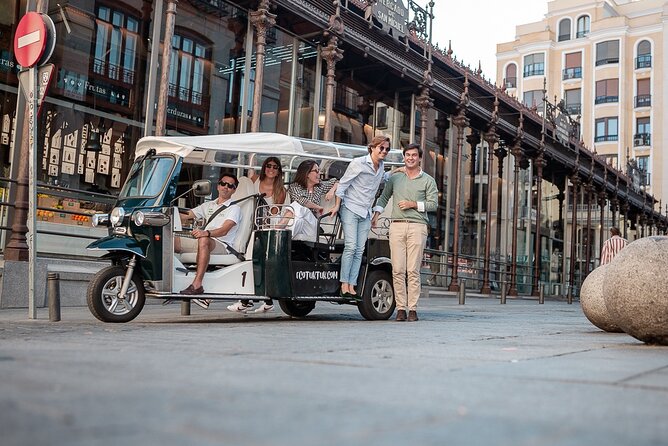
Madrid is a large city with its sights spread across broad avenues, grand squares, and several historic districts. This private electric tuk-tuk tour gives you a fast, comfortable look at the center, from the Royal Palace and Almudena Cathedral to the Prado Museum, Puerta de Alcalá, and the Temple of Debod. It is especially useful at the start of a visit, when you want to understand the city before choosing where to return on foot.
I like the small private format, with no strangers sharing your vehicle and a maximum of four passengers per tuk-tuk. I also like the practical touch of blankets and weather layers, plus guides such as Carlos, Laura, Christian, Fernando, and Gustavo, who are praised for clear explanations, humor, directions, and local food suggestions.
The main trade-off is speed. You cover a lot, but this is an orientation ride rather than a series of long visits. You cannot freely add stops or change the route, and a late arrival can shorten the tour or cancel it if you are more than 15 minutes behind.
Key points to know before booking

- A private tuk-tuk carries up to four people, making this a good fit for couples, families, or a small group.
- The route links Madrid’s biggest sights, including the Royal Palace, Prado Museum, Atocha Station, Cibeles, and the Temple of Debod.
- The tour is best for getting your bearings, not for entering museums, palaces, or churches at length.
- Blankets and protective layers are provided, so cooler weather is manageable, though the vehicle remains open to the elements.
- English-speaking guides add useful context, restaurant ideas, and suggestions for what to revisit later.
- The meeting point is underground near the Royal Palace, so allow extra time to find the correct entrance.
Why this is a smart first look at Madrid
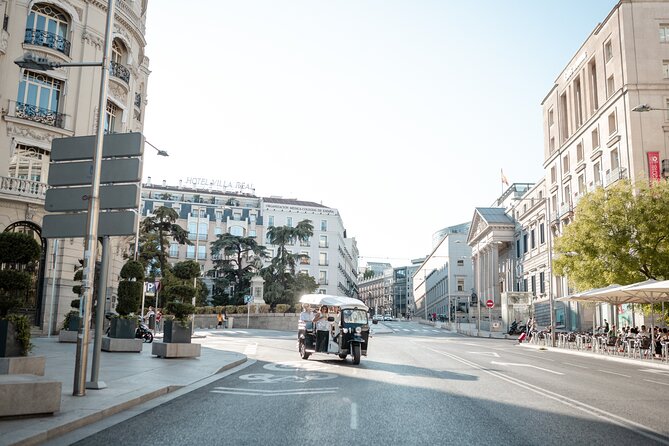
I see this tour as a moving introduction to central Madrid. The tuk-tuk lets you cover ground without committing to a long walking route, while the guide explains what you are passing and helps you decide what deserves more time later.
That matters in Madrid. The city center is easy to explore on foot once you understand its shape, but the major sights are not all clustered around one square. The Royal Palace and Temple of Debod sit west of the main central area. The Prado, Atocha, Retiro edge, Cibeles, and Puerta de Alcalá stretch east and south. A tuk-tuk connects these areas quickly.
The format also suits a short stay. A one-hour ride gives you a brisk overview. A two-hour version gives the guide more room for stories, neighborhoods, and photo stops. The listed duration can run from about one to four hours, depending on the option booked, so check your selected time carefully.
You will not receive a museum visit or a formal walking tour at each monument. Instead, expect a private ride with selected places to stop for photographs and explanations from the driver-guide. That makes the tour most useful before you return to the Prado, Royal Palace, or Cathedral on your own.
More Electric Tuk Tuk Tours in Madrid
- Madrid: Private City Tour by Eco Tuk Tuk
★ 4.9 · 3,465 reviews - Madrid Historical Tour with Local Guide in Eco Tuk Tuk Private
★ 5.0 · 876 reviews - Madrid Express Tour with Local Guide in Eco Tuk Tuk Private
★ 5.0 · 413 reviews
The Royal Palace and Almudena Cathedral
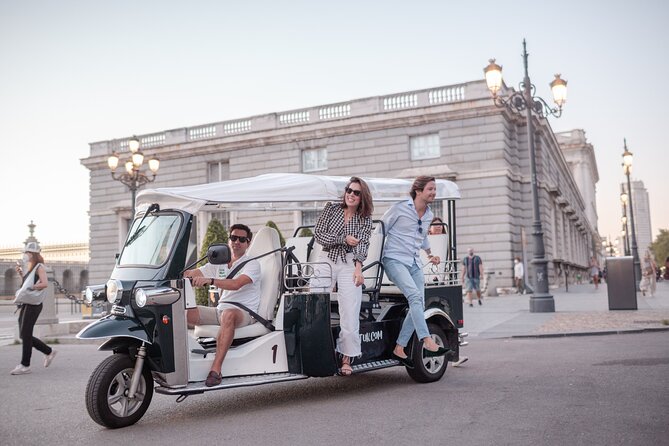
The meeting point is beside Madrid’s Royal Palace, so the tour begins in one of the city’s grandest settings. The palace is still the official residence of Spain’s king, although the current royal family lives at the Palace of Zarzuela. The building is now mainly used for state ceremonies and formal events.
The tuk-tuk offers a good first look at the palace exterior, but do not confuse this ride with palace admission. If you want to see the ceremonial rooms, you will need a separate visit.
Across from the palace is Almudena Cathedral, Madrid’s main religious building. It was consecrated by Pope John Paul II in 1993 and is noted as the first cathedral consecrated outside Rome by a pope. Its museum presents objects connected with the Diocese of Madrid, including mosaics, episcopal shields, and religious ornaments.
The cathedral and palace make a natural opening pair. One represents the Spanish monarchy, the other the city’s Catholic tradition. Your guide can give you the basic story while you remain seated, then you can return later if you want a closer look.
Nearby, the Sabatini Gardens provide a more measured view of the palace’s northern side. These formal gardens cover about 2.66 hectares between Bailén Street and the San Vicente Coast. They are a pleasant place to revisit on foot, particularly if you want photographs away from the palace’s main entrance.
From San Francisco el Grande to the Congress of Deputies
The route also reaches the Royal Basilica of San Francisco el Grande, officially the Basilica of Our Lady of the Angels. It sits in Madrid’s historic center in the Palace district and gives the ride another angle on the city’s religious architecture.
You should think of this as a passing visit and orientation point unless your chosen tour includes a longer stop. The value is in seeing how the basilica fits into the older central districts and hearing the guide place it within Madrid’s broader story.
The Palace of the Spanish Courts brings you into the political center of the capital. The building occupies the former site of the Convent of the Holy Spirit, which served as the seat of Congress from 1834 to 1841. Its neoclassical front has six Corinthian columns, a triangular pediment, and the famous lions at the entrance.
Those lions were cast from iron taken from cannons captured during the African War. The bronze doors normally open only for major occasions, so the exterior details are the main attraction on this ride. Inside are the Session Hall, library, and Conference Hall, also known as the hall of the lost steps, but this tuk-tuk experience does not include a stated interior visit.
This section of the route is useful because it shows Madrid as a working capital, not just a collection of palaces and museums.
Cibeles, Neptune, and Madrid’s football map
Two fountains connect classical mythology with modern football. Cibeles depicts the Roman goddess Cybele on a chariot pulled by two lions. Neptune shows the Roman god of the sea. Both fountains were part of Ventura Rodríguez’s original plan and initially faced one another across the Paseo del Prado before being moved into their current squares in the late nineteenth century.
Cibeles is surrounded by several important buildings, including the former post office headquarters, now Madrid City Hall, the Bank of Spain, the Buenavista Palace, and the Linares Palace, home to the House of America. The setting gives you a concentrated view of Madrid’s grand civic architecture.
The football connection adds a distinctly local layer. Real Madrid celebrates major titles at Cibeles, while Atlético Madrid supporters gather at Neptune. The fountains are not only decorative monuments. They are part of the city’s sporting identity and an easy way for a guide to explain how Madrid’s rival football cultures occupy different corners of the center.
The Bank of Spain is another striking building along this stretch. It was designed to give the National Bank a headquarters suited to its role, including the issuing of coins and banknotes for the entire country. The interior is generally not open for ordinary sightseeing, with access limited to certain educational, university, cultural, and nonprofit groups.
More Electric Tuk Tuk Tours in Spain
- Madrid: Highlights City Tour by Electric Tuk Tuk
★ 4.7 · 346 reviews - Madrid Expert Tour with Local Guide in Eco Tuk Tuk Private
★ 5.0 · 220 reviews - Madrid Expert Plus Tour with Local Guide in Eco Tuk Tuk Private
★ 5.0 · 162 reviews - Tour Madrid: Secrets in a Electric Tuk Tuk
★ 4.6 · 155 reviews
The Prado Museum and the Jerónimos district
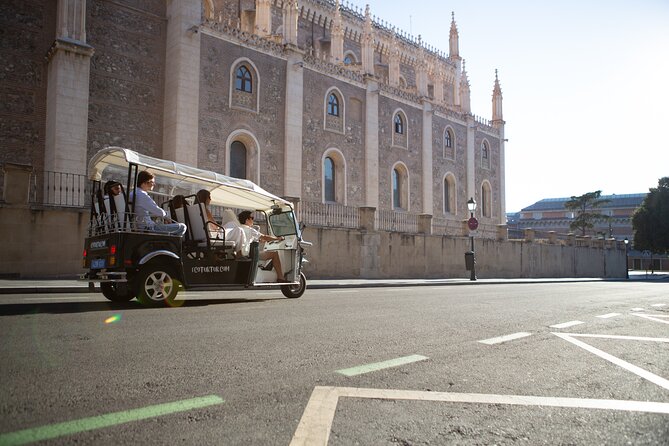
The Prado Museum is the artistic anchor of the route. Its collection covers European painting from the sixteenth through nineteenth centuries, with major works by Velázquez, El Greco, Goya, Titian, Rubens, and Bosch. It also includes important paintings by Murillo, Ribera, Zurbarán, Fra Angelico, Raphael, Veronese, Tintoretto, Van Dyck, and Poussin.
A tuk-tuk ride cannot do justice to the museum’s galleries, but it can help you place the Prado within Madrid’s cultural district. If you have only one museum visit in the city, this is the one that deserves serious time, not a rushed stop between other sights.
The nearby monastery of San Jerónimo el Real, usually called Los Jerónimos, adds another layer. It was once one of Madrid’s most important monasteries and stood beside the Royal Room, later expanded under Philip IV into the Palace of the Good Retreat.
This area rewards a second visit on foot. You can pair the Prado with the Jerónimos church, the Retiro side of the city, and the nearby gardens. The tuk-tuk gives you the layout first, which can save time when you return independently.
Atocha Station and the city’s east side
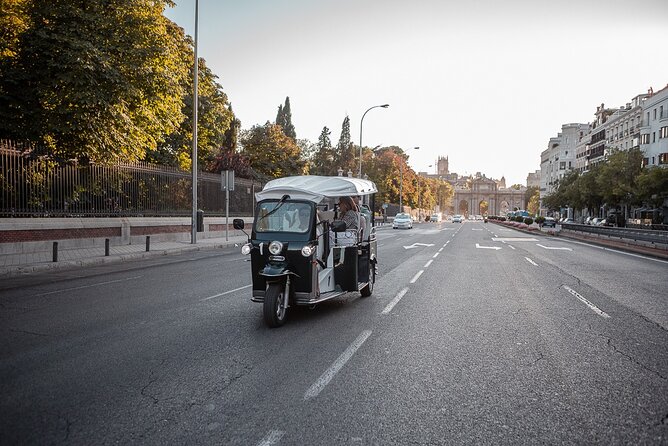
Atocha is more than a transport stop. It is Madrid’s busiest passenger station and one of Europe’s major rail hubs, located near Emperor Charles V Square. The complex connects long-distance rail, regional services, and local movement through the city.
Seeing Atocha during the tour is useful if you are arriving or departing by train. It helps you recognize the station’s position relative to the Prado, Retiro area, and central Madrid. If you are carrying luggage, however, remember that the tour does not include hotel pickup, drop-off, or transfers outside the planned route.
The route also reaches Puerta de Alcalá, one of the five old royal gates that once gave access to Madrid. It now sits in the center of the Independence Square roundabout. The monument is best appreciated as part of the city’s changing boundaries, when Madrid was expanding beyond its older core.
Plaza de Santa Ana offers a different mood. This open space in the Cortes district dates from 1810 and has changed through several urban redesigns. It is a useful stop for seeing how Madrid’s public squares shift from monumental spaces to places tied to everyday city life.
Debod Temple and the final view

The Temple of Debod is one of Madrid’s most unusual sights. This ancient Egyptian building now sits west of the Spanish Steps, near the Paseo del Pintor Rosales, on high ground once occupied by the Mountain Barracks.
The temple is a free sight, and the listed stop allows about 10 minutes. That is enough for a look and photographs, but not necessarily enough for a slow visit. Its setting gives you a broad change of scene from the dense central streets and palace district.
Because the temple is near the end of the route, it can help you understand Madrid’s west side. It is also a good reminder that the city is not defined only by Spanish royal and Catholic monuments. The route brings together Egyptian architecture, Greek mythology, Spanish monarchy, national politics, major art, football traditions, and modern rail travel.
What the ride feels like in different weather

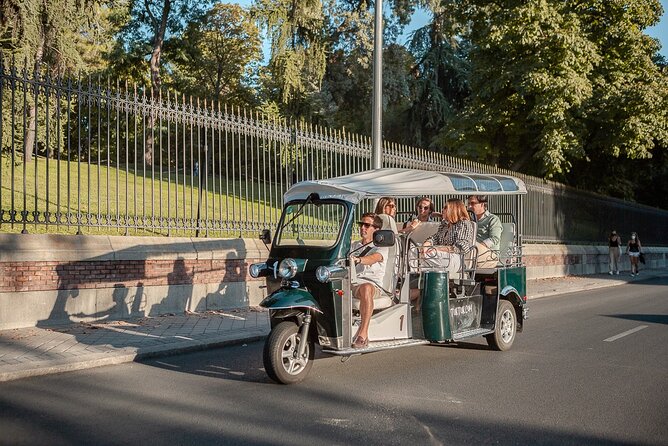
The tuk-tuk is electric, private, and open enough that weather matters. Tours run in rain or heat and are cancelled only under extreme conditions, so you should dress for the forecast rather than assume a fully enclosed vehicle.
Blankets and protective layers against rain and wind are provided. That is particularly helpful in winter, when the ride can feel colder than a normal street walk. Some people have taken the tour around Christmas and found the blankets made the experience workable despite the cold.
The vehicle is suitable for older people, and the driver can help with boarding. A mobility issue does require planning, though, because the pickup area is reached through an underground bus station. Contact the operator by phone, WhatsApp, or email if you need elevator access.
Children must be at least two years old, and babies are not allowed. A minimum weight of 9 kilograms applies. Pets are not permitted for safety reasons.
Meeting point advice that can save you a missed tour
The official meeting point is C. de Bailén, 4, beside the Royal Palace. The confusing part is that there is no visible number 4 on Calle Bailén. Search for Calle Bailén 4 or Puerta del Príncipe on Google Maps.
The actual access is in the underground station beneath Plaza de Oriente, opposite the Prince’s Gate. Look for the stairs and Eco Tuk Tuk signs. Do not wait beside the palace’s side entrances and assume you are in the right place.
Arrive early. If you are late, the activity time is reduced according to the time lost. A delay of more than 15 minutes can lead to cancellation without a refund. Street closures and demonstrations can also change the route on the day.
The tour finishes back at the same meeting point. Hotel pickup and drop-off are not included and are not legally available for this activity.
Is $28.66 a good value?
At about $28.66 per person, the price is attractive for a private city introduction, particularly if four people share one tuk-tuk. The cost is based on the number of vehicles needed, and each vehicle carries a legal maximum of four passengers, so a larger group may need more than one tuk-tuk.
The real value comes from saved time and the private guide. You cover many important parts of central Madrid without arranging several metro trips or walking between distant sights. You also receive direct suggestions about where to eat and what to revisit, which guides such as Fernando, Gus, Bobby, and Alejandro have provided during tours.
The price is less compelling if you want long museum visits, extensive walking, or a flexible route built around your own interests. The route and photo stops are prearranged, and the tour cannot be modified during the ride.
Free cancellation is available if you cancel at least 24 hours before the start time. Changes or cancellations made inside that window are not refunded.
Who should book this Madrid tuk-tuk tour?
I would choose this for a first visit, a short stay, a family group, or anyone who wants to reduce walking while still seeing the center. It is also useful for older people, provided the underground meeting point is arranged in advance if stairs are difficult.
It suits you especially well if you want a lively introduction rather than a lecture. Guides including Laura, Christian, Manuel, Roberto, Carlos, and Juan Pablo have been praised for humor, clear directions, history, patience, and practical suggestions.
I would skip it if your main goal is to enter the Royal Palace, spend hours in the Prado, or stop wherever you please. In that case, a walking tour or separate admission visits will give you more time at each place.
Should you book it?
Book this tour if you want to get your bearings fast and see how Madrid’s main districts connect. The private electric vehicle, small group size, helpful guides, and weather gear make it a comfortable way to begin a city visit.
Choose the two-hour option if your schedule allows. One hour is efficient but fast, while two hours gives you more room for explanations and photographs. Arrive early at the underground Plaza de Oriente meeting point, dress for the weather, and treat the ride as a smart preview of Madrid rather than a replacement for its museums and monuments.
FAQ
How long does the Madrid tuk-tuk tour last?
The experience lasts approximately one to four hours, depending on the option selected. One-hour and two-hour rides are specifically described in the tour information.
How many people can ride in one tuk-tuk?
Each tuk-tuk has a legal maximum of four passengers. Private vehicles are reserved for your group only, and larger groups may require more than one tuk-tuk.
Is the tour offered in English?
Yes. The tour is offered in English with an English-speaking driver-guide.
Where does the tour begin?
It begins near the Royal Palace at C. de Bailén, 4, in central Madrid. The pickup point is in the underground bus station beneath Plaza de Oriente, opposite the Prince’s Gate.
Where does the tour finish?
The tour ends back at the same meeting point.
Does the tour include hotel pickup and drop-off?
No. Hotel pickup and drop-off are not included, and transfers outside the tour route are not available.
Are blankets available in cold weather?
Yes. Blankets and protective layers against rain and wind are provided. Tours operate in rain or heat unless conditions are extreme.
Can babies or pets join the tour?
Babies are not allowed. Children must be at least two years old, and a minimum weight of 9 kilograms applies. Pets are not permitted.
Can I cancel for a full refund?
Yes, if you cancel at least 24 hours before the experience begins. Cancellations or changes made less than 24 hours before the start time are not refunded.
More Private Tuk Tuk Tours in Madrid
- Madrid: City Tours – 6 seats private ecological tuk tuk
★ 4.6 · 230 reviews - “See Madrid Differently: A Premium Private Tuk Tuk Ride”
★ 4.7 · 159 reviews - Christmas Lights Tour of Madrid in Eco Tuk Tuk Private
★ 5.0 · 125 reviews - Madrid: Eco-Friendly, Private, and Unique Tuk Tuk Experience
★ 4.9 · 105 reviews
More Guided Tuk Tuk Tours in Spain
- Madrid in Tuk Tuk with Local Guide Included
★ 5.0 · 5 reviews - Tour Welcome Barcelona with Local Guide in Eco Tuk Tuk Private
★ 5.0 · 1,882 reviews - Tour Welcome Seville with Local Guide in Eco Tuk Tuk Private
★ 5.0 · 786 reviews - Malaga Expert Tour with Local Guide in Eco Tuk Tuk Private
★ 5.0 · 533 reviews
Just added around Madrid
- Tuk-tuk tour of downtown Madrid★ 5.0 · 2 reviews
- Tour Madrid: Royals, Plazas & Secrets 3H★ 4.5 · 14 reviews
- Discover Madrid in a Fun & Eco-Friendly Tuk-Tuk – Private Tour★ 4.0 · 4 reviews
- Eco Friendly Tuk Tuk Experience with the Local in Madrid★ 5.0 · 4 reviews
- Tour en tuk-tuk electrico por MADRID MODERNO★ 4.5 · 60 reviews
- Tuk Tuk Tour of the Best of Madrid (booking only)★ 5.0 · 2 reviews
- Madrid Tuk Tuk & Olé Experience – Private 1.5h Cultural Tour★ 5.0 · 7 reviews
- Madrid in Tuk Tuk with Local Guide Included★ 5.0 · 5 reviews
Electric and Eco Tuk Tuk Tours, compared.
Tour Welcome Barcelona with Local Guide in Eco Tuk Tuk Private
Read our review →
Discover Porto’s Highlights on a 2-Hour Private Electric Tuk Tuk
Read our review →
Welcome Lisbon Tour with Local Guide in Private Eco Tuk Tuk
Read our review →