
REVIEW · 3-HOUR EXPERIENCES
Tour Madrid: Royals, Plazas & Secrets 3H
Madrid packs royal grandeur, literary history, grand boulevards, football, and Egyptian antiquities into a surprisingly compact city. This private three-hour tour covers an astonishing amount of ground, from the Royal Palace and Plaza Mayor to Las Ventas and the Santiago Bernabéu Stadium. It is a fast way to get your bearings, especially if your time is short.
I like the private format for up to four people, since your guide can adjust the route and answer your questions. I also like the sheer range of sights, including places many quick city tours skip, such as the Debod Temple, the National Library, and the Salamanca district. The tradeoff is clear: three hours and 27 stops means mostly outside views, not long visits inside museums or monuments.
Key points to know before booking
- Private ride for up to four: You have the vehicle and guide to yourself, with room for the route to reflect your interests.
- A citywide overview: The tour links the old center, royal Madrid, the Prado area, Salamanca, the financial district, and Retiro.
- English-language guiding: The experience is offered in English, with guides including Rommel, Javier, Maria, Daniel, and others.
- Photo stops matter most: Many stops last only five or ten minutes, so expect brief explanations, views, and pictures rather than full visits.
- The Royal Palace costs extra: Admission to the Palacio Real is not included, and five minutes is not enough for an interior tour.
- Good for a short stay: The route is designed to show Madrid’s broad shape quickly, rather than explore one neighborhood at a slow pace.
A fast ride from royal Madrid to modern Madrid
The route begins at Plaza de la Lealtad, near the Retiro and Prado area, and ends back at the same meeting point. At $323.59 per group of up to four, the price is easiest to justify when you fill the vehicle. Split among four people, it works out to about $81 per person for a private three-hour orientation.
That is not a bargain in the way a free walking tour is, but it buys something different: speed, privacy, and a guide who can move you across Madrid without asking you to cover the same distance on foot. If you are visiting for only a day or two, that can be useful.
The tour is offered in English and is confirmed at booking. Most people can participate, and service animals are allowed. Public transportation is nearby, but the point of this experience is to let you see distant parts of the city without arranging each transfer yourself.
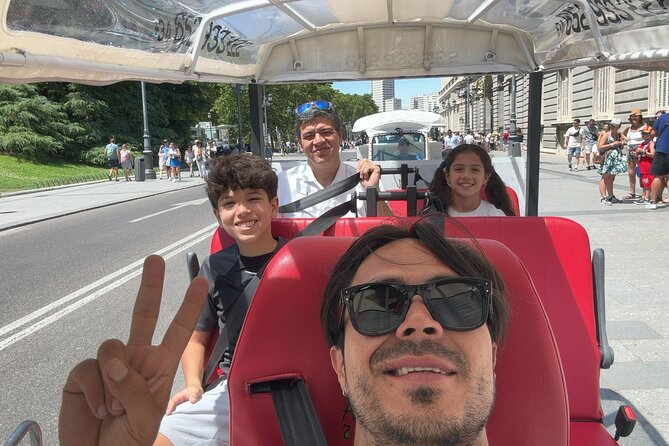
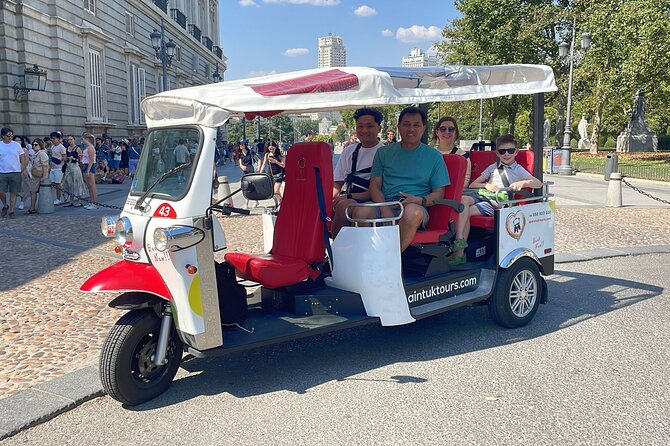
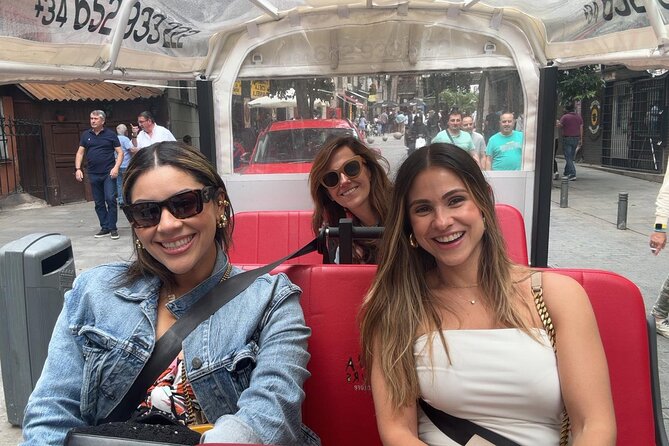
The route appears to use a tuk tuk style vehicle, based on the ride and driver descriptions. That gives you a close-up view of the streets, but traffic noise can matter. One guide, Alvaro, was reported to have no proper microphone or public address system, which made parts of the explanation hard to hear. You should be ready to ask the driver to repeat details if traffic drowns them out.
More Three-Hour Experiences in Madrid:
- Visiting 9 Places in 3 hours Share Tour by Tuk-Tuk
★ 4.9 · 293 reviews - Tuk Tuk Athens Complete City Center Tour – 100% Electric (3 hour)
★ 5.0 · 252 reviews - Athens: Private 3-Hour City Tour on Eco-Friendly Tuk Tuk
★ 4.8 · 248 reviews
Plaza de Santa Ana and the literary center

Plaza de Santa Ana is a brief opening stop in the Cortes neighborhood. The square dates from 1810 and has changed many times as Madrid reshaped its streets and public spaces.
You will not have time here for a long café break or a careful look at every building. Instead, it gives you an early taste of central Madrid before the route moves toward the royal quarter. The short stop also helps you understand how close Madrid’s grand sights are to ordinary streets, restaurants, and neighborhood squares.
The literary thread returns later at the homes connected with Miguel de Cervantes and Lope de Vega. Cervantes, author of Don Quijote, once lived at Casa de Cervantes, while Lope de Vega bought his house on Cervantes Street in 1610 and lived there until his death in 1635.
These homes are listed as free stops, but the three-hour schedule does not allow a full house-museum visit. If Cervantes or Lope de Vega is a main reason for your visit, treat this tour as a useful exterior orientation and plan a separate visit.
Royal Palace, Almudena Cathedral, and Sabatini Gardens
The Royal Palace is the tour’s grandest royal sight. Construction began in 1738 after fire destroyed the earlier Habsburg palace on Christmas Eve in 1734. The new palace was completed after 17 years, and Carlos III made it his regular residence in 1764.
Spain’s royal family now lives at the Palacio de la Zarzuela, so the Royal Palace is used for receptions, ceremonies, and official events. It is also called the Palacio de Oriente, a name you may hear while exploring this part of Madrid.
The stop is only five minutes, and palace admission is not included. That tells you exactly how to use this part of the experience: admire the exterior, hear the basic story, and decide if you want to return for a proper interior visit. The palace’s state rooms, art, and ceremonial spaces require more time than this tour provides.
The nearby Almudena Cathedral gives you a different view of Madrid’s public life. It was consecrated by Pope John Paul II on June 15, 1993, and became the first cathedral consecrated outside Rome. Its museum contains objects connected with the Diocese of Madrid, including mosaics, episcopal shields, and religious ornaments.
The museum stop is listed as free and lasts about ten minutes. That may be enough for a quick look, but not a careful study of the collection. The same is true of the cathedral itself: you will gain context, but anyone interested in architecture or religious art should return independently.
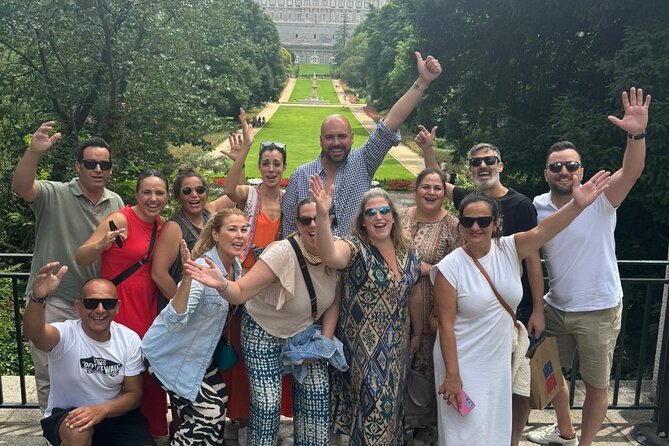
Sabatini Gardens sit beside the north side of the palace. Their 2.66 hectares offer a calmer setting, with formal planting and palace views. Ten minutes is enough for a quick walk and photographs, particularly if you want a pause from Madrid’s traffic.
Debod Temple and the old city squares
The Temple of Debod is one of Madrid’s most unexpected sights. It is an ancient Egyptian building now located on a hill near Plaza de España, beside the Paseo del Pintor Rosales. The setting gives the tour a welcome change of mood after the palace and cathedral.
Because the admission is free, this stop can be especially appealing to first-time visitors who want something beyond standard royal and museum sights. The schedule does not specify a separate duration, so your time here may depend on traffic, the guide, and your chosen photo stops.
Plaza Mayor is the heart of old Madrid, known as Madrid de los Austrias. Its porticoed buildings sit on the site of the former Plaza del Arrabal, once home to a popular market. Juan Gómez de Mora was asked in 1617 to bring uniformity to the buildings around the square.
The square has hosted public celebrations, bullfights, beatifications, coronations, and religious ceremonies. Today, it is one of the easiest places to picture Madrid before wide avenues and modern traffic changed the city.
A ten-minute stop lets you look across the square and hear its main story. It will not give you time to explore the surrounding lanes at leisure, so use the guide’s explanation as a preview. Mercado de San Miguel is nearby, a covered market dating from around 1916 with food stalls, delicatessen items, and events in an elegant setting.
The market is listed as a free stop, but food purchases are not included. If you want to eat here, the tour’s schedule is not designed around a meal. Lunch and dinner are specifically excluded, so plan to return later if you want to sample the market properly.
Same place, a completely different ride:
- Madrid: Private City Tour by Eco Tuk Tuk
★ 4.9 · 3,465 reviews - Madrid Welcome Tour with Local Guide in Eco Tuk Tuk Private
★ 5.0 · 2,936 reviews - Madrid Historical Tour with Local Guide in Eco Tuk Tuk Private
★ 5.0 · 876 reviews - Madrid Express Tour with Local Guide in Eco Tuk Tuk Private
★ 5.0 · 413 reviews
Churches, writers, and the Spanish Parliament
The Royal Basilica of San Francisco el Grande is another brief look at Madrid’s historic center. Officially the Basilica of Our Lady of the Angels, it sits in the Palacio neighborhood. Its size and position make it one of the notable religious buildings in the old center.
The route then reconnects with Madrid’s literary past at Casa de Cervantes and Casa Museo Lope de Vega. These stops add useful texture to the royal and political sights. Madrid was not only a city of palaces and government buildings, but also a home for writers who shaped Spanish literature.
Plaza de las Cortes brings the tour into Spain’s political center. The Palace of the Spanish Courts was built on the site of the former Convent of the Holy Spirit, which served as the seat of Congress between 1834 and 1841.
Look for the neoclassical portico, its six Corinthian columns, the triangular pediment, and the lions at the entrance. The lions were made with iron from cannons captured during the war in Africa. The building’s interior rooms, including the Session Room and library, are not part of this brief outdoor stop.
The Prado district and Madrid’s grand fountains
Neptune Fountain sits in Plaza de Cánovas del Castillo, close to the Prado Museum. The neoclassical fountain was proposed in 1777, built from 1782 to 1786, and shows the Roman god Neptune.
The Prado Museum is one of Europe’s great painting collections, particularly strong in Velázquez, El Greco, Goya, Titian, Rubens, and Bosch. It also holds important works by artists such as Murillo, Ribera, Zurbarán, Raphael, Veronese, Tintoretto, Van Dyck, and Poussin.
The schedule lists the Prado as a free stop, but this should not be confused with included museum admission. The tour gives you the building and its setting, not enough time for the galleries. If the Prado is a priority, reserve several hours on another part of your trip.
The nearby church of San Jerónimo el Real is popularly known as Los Jerónimos. It is a late Gothic building with Renaissance touches and has a long connection with Spain’s monarchs. It served as a royal retreat and hosted royal investitures when Madrid had no cathedral.
These three stops work well together. Neptune represents the city’s grand civic decoration, the Prado represents its art, and Los Jerónimos connects the area to the monarchy. You see the relationship quickly, even though you do not enter each site for a full visit.
Puerta de Alcalá, Retiro, and the east side
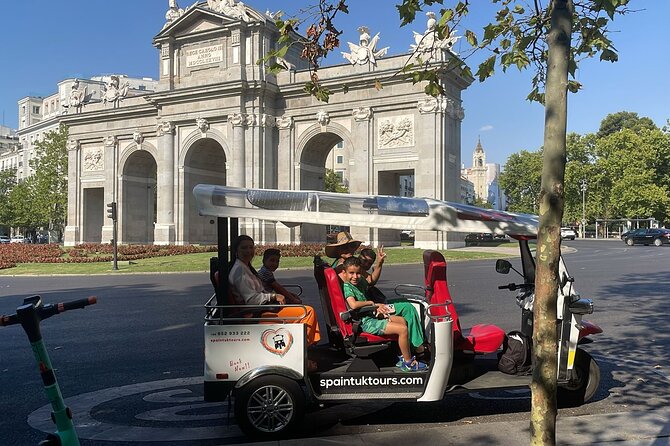
Puerta de Alcalá was commissioned by Carlos III to replace an earlier gate and opened in 1778. Designed by Francesco Sabatini, it is a granite neoclassical arch with five openings, an unusual feature compared with the more common three-opening design.
The two sides have different decoration. One faces the former city and carries the four virtues of Prudence, Justice, Temperance, and Fortitude. The outer side has the royal coat of arms and more elaborate decoration for people entering Madrid.
The five-minute stop is enough for a photo and a concise explanation. It also puts you beside Parque del Retiro, one of Madrid’s major green spaces. The vehicle goes around the park and can stop for photographs at the main entrance, but this is not a walking visit through the gardens.
You will get a sense of Retiro’s scale and location, then continue along Paseo del Prado toward Atocha station. The route is particularly useful for seeing how the park, museum district, and grand avenues fit together on a map.
Las Ventas, Salamanca, and the Bernabéu
Las Ventas is Madrid’s famous bullring and one of the largest bullfighting arenas in Spain. Its capacity is listed at 23,798, and its ring measures 61.5 meters in diameter.
The stop is scheduled for about ten minutes. That works for an exterior look and an explanation of bullfighting’s place in Spanish culture. It does not provide time for a full arena visit or a bullfight, and tickets are not included.
The tour then passes through the Barrio de Salamanca along streets including Velázquez, Ortega y Gasset, and Serrano. This district gives you a different side of Madrid, with broad streets and high-end shopping. It is a drive-through section rather than a shopping excursion, but it helps you compare the old center with the city’s more polished nineteenth-century expansion.
From Salamanca, the route follows the Paseo de la Castellana to Santiago Bernabéu Stadium. The stadium opened on December 14, 1947, and now holds 81,044 people. You get a quick view of the home of Real Madrid, not a stadium tour or match ticket.
For football fans, even a short stop can be worthwhile. For everyone else, it is a useful marker of Madrid’s modern identity and the long north-south axis of the city.
Cibeles, Gran Vía, and the final city sweep
Plaza de Colón features a 17-meter white-marble monument to Christopher Columbus, completed in 1885. The nearby Gardens of Discovery include sculptures linked to the discovery of America, and the Fernán Gómez Cultural Center sits below the square.
The National Library of Spain is another notable exterior along this part of Madrid. It safeguards about 30 million publications produced in Spain since the early eighteenth century, including books, magazines, maps, prints, drawings, scores, and pamphlets.
Cibeles Fountain is one of Madrid’s most recognizable meeting points. The Roman goddess Cibeles rides a chariot pulled by two lions, and the surrounding buildings include the former post office palace, the Bank of Spain, the Linares Palace, and the Buenavista Palace.
The fountain also has a direct link to football: Real Madrid supporters celebrate major titles there, as does Spain’s national team. That makes the stop more than decorative if you follow Spanish football.
The Bank of Spain is admired from outside because interior visits are restricted to educational institutions and certain nonprofit cultural groups. Gran Vía then brings the route back toward Madrid’s commercial and entertainment center. Built in the early twentieth century, it runs from Alcalá Street to Plaza de España.
The Teatro Real, Madrid’s roughly 200-year-old opera house, completes the city-center sweep. With the Royal Palace, Plaza Mayor, Gran Vía, and the Prado area all connected in one ride, you leave with a useful mental map of central Madrid.
What guides add to the experience
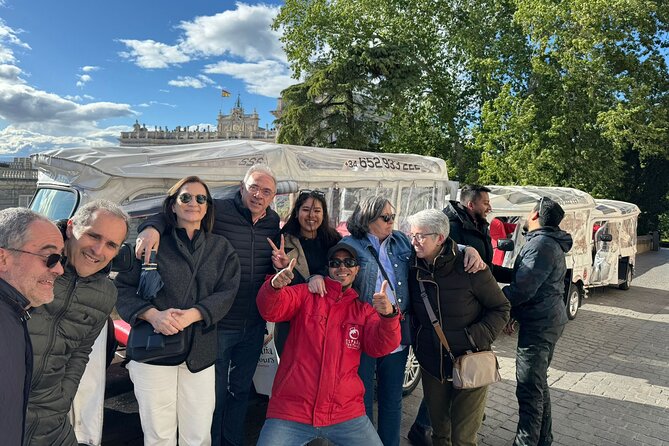
The strongest part of this tour is the guide’s ability to shape a fast route around your interests. Rommel adjusted the experience to suit one guest’s priorities. Javier was described as personable and professional, while Maria brought humor and adapted the route to the limited time available.
Daniel answered many questions during a cross-city ride, and Radeon was praised for stopping for photographs. These details matter because a tour with this many sights can otherwise feel like a checklist.
The guiding quality is not guaranteed to be identical every time. A clear microphone is important in traffic, and one ride had sound problems. Ask questions, request repeats, and tell the guide early if you want more time at one sight and less time at another.
The route is private, so you have more control than you would on a large group outing. Still, the guide cannot turn 27 stops into 27 proper visits. The best approach is to choose two or three priorities before setting off, then use the rest as a city overview.
Who should book this Madrid tour?
I would choose this experience if you have limited time, want to see distant parts of Madrid in one sitting, or prefer a private ride to a group excursion. It is also useful at the beginning of a longer stay, since you can mark places such as the Prado, Retiro, Plaza Mayor, or Mercado de San Miguel for later visits.
I would not choose it as your only Madrid sightseeing plan if you want to tour the Royal Palace, spend hours in the Prado, explore Retiro on foot, or visit the writers’ houses inside. The short stops are built for orientation and photographs.
At $323.59 for up to four people, the value improves sharply when shared. Free cancellation is available up to 24 hours before the start time, but cancellations or changes within 24 hours are not refunded. The meeting point is Plaza de la Lealtad, and the ride returns there at the end.
Should you book it?
Book this tour if your goal is to see Madrid’s full spread quickly and have a private English-speaking guide connect the pieces. The combination of royal sights, old squares, art landmarks, bullfighting, football, shopping streets, and modern business districts is its main strength.
Skip it if you want slow museum visits or detailed interior tours. For most short-stay visitors, though, this is a practical first look at Madrid, provided you accept the tradeoff: lots of ground covered, brief stops, and a few sights saved for another day.
FAQ
How long does the Madrid tour last?
The tour lasts approximately three hours.
How many people can join the private tour?
The price covers one private group of up to four people.
What language is the tour offered in?
The tour is offered in English.
Where does the tour begin and end?
It begins at Plaza de la Lealtad, 1, in Madrid’s Retiro area, and ends back at the same meeting point.
Is admission to the Royal Palace included?
No. Admission to the Palacio Real is not included in the tour price.
Are meals included?
No. Lunch and dinner are not included.
Can I cancel for a full refund?
Yes, if you cancel at least 24 hours before the experience starts. Cancellations or changes made less than 24 hours before the start time are not refunded.
Just added around Madrid
- Tuk-tuk tour of downtown Madrid★ 5.0 · 2 reviews
- Discover Madrid in a Fun & Eco-Friendly Tuk-Tuk – Private Tour★ 4.0 · 4 reviews
- Eco Friendly Tuk Tuk Experience with the Local in Madrid★ 5.0 · 4 reviews
- Tour en tuk-tuk electrico por MADRID MODERNO★ 4.5 · 60 reviews
- Tuk Tuk Tour of the Best of Madrid (booking only)★ 5.0 · 2 reviews
- Madrid Tuk Tuk & Olé Experience – Private 1.5h Cultural Tour★ 5.0 · 7 reviews
- Madrid in Tuk Tuk with Local Guide Included★ 5.0 · 5 reviews
- Tuk Tuk Zero Private Tour: The Best of Madrid in 2hrs. 15min.★ 3.0 · 2 reviews
3-Hour Experiences, compared.
Visiting 9 Places in 3 hours Share Tour by Tuk-Tuk
Read our review →
Tuk Tuk Athens Complete City Center Tour – 100% Electric (3 hour)
Read our review →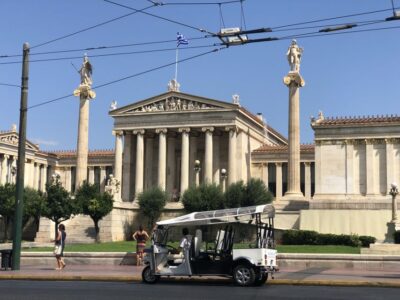
Private 3-Hour City Tour on Eco-Friendly Tuk Tuk
Read our review →
3-hour Old Delhi Heritage Walking tour with Rickshaw Ride
Read our review →
Small-group Saigon City Tour: 3-Hour Cyclo Ride to Hidden Stories
Read our review →3-Hour Old Delhi Heritage Walking tour with Rickshaw ride
Read our review →

3-Hour Sightseeing Tuk-Tuk Tour with Free Pickup
Read our review →Where else this ride shows up