
REVIEW · PRIVATE TUK TUK TOURS
Madrid Tuk Tuk & Olé Experience – Private 1.5h Cultural Tour
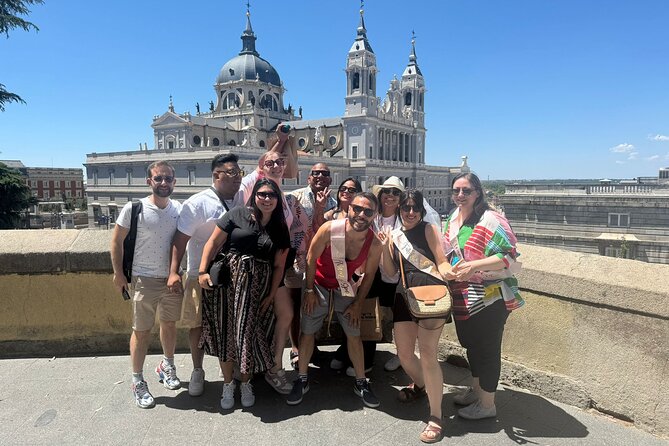
Madrid’s biggest sights come quickly on this private tuk tuk tour, which links royal buildings, grand plazas, museums, old gates, and shopping streets in just 90 minutes. You ride with only your own group, up to four people, so the experience feels more personal than a large bus tour.
I like the efficient route and the chance to hear stories from guides such as Sebastian, Pedro, Pablo, Simon, and Charlie. I also like that the driver can point out places you may miss on foot, then offer tips on neighborhoods for later walks and meals. The main drawback is time: with 18 listed sights, most stops are for a look and an explanation, not a full visit inside.
Key points to know before booking
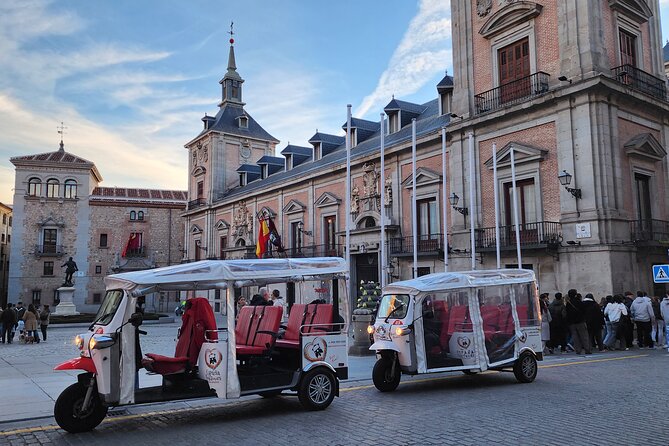
- Private tuk tuk for up to four people: Your group has the vehicle and guide to itself.
- A fast look at Madrid’s main sights: The route covers royal Madrid, the art district, Retiro, Salamanca, Las Ventas, and Gran Vía.
- Best for first-day orientation: Ninety minutes gives you a useful map of the city before exploring on foot.
- English service: The tour is offered in English. Sebastian has also guided guests in Italian, though you should not assume that language is guaranteed.
- Early departure can help: Traffic may slow the route later in the day, so an earlier start is worth considering.
- No museum admission or meals included: Listed admission is free, while lunch and dinner are not part of the price.
Madrid in 90 minutes, from a small open vehicle
This tour is built for seeing rather than entering. The tuk tuk lets you cover far more ground than you could comfortably walk in an hour and a half, while still giving you a guide who can explain what you are looking at.
For a private group, the price is $167.02, or about $41.76 per person if four people share it. That is not the cheapest way to see Madrid, but it is fair for a private vehicle, a dedicated guide, and a route that covers much of central Madrid. For two people, the cost per person is much higher, so the value improves when you fill all four seats.
I would use this as an introduction, not as a replacement for Madrid’s museums and historic interiors. You get your bearings fast, note the places that deserve more time, and return later on foot. That makes the tour especially useful on your first day or when your schedule is tight.
The start and finish point is Pl. de la Lealtad, 1, in the Retiro area. The tour returns to that meeting point. Since the route passes through busy central streets, an early departure may be wise. Simon has advised guests that traffic can become slower as the day goes on, and that practical tip matters on a short tour.
More Private Tuk Tuk Tours in Madrid
- Madrid: Private City Tour by Eco Tuk Tuk
★ 4.9 · 3,465 reviews - Madrid Welcome Tour with Local Guide in Eco Tuk Tuk Private
★ 5.0 · 2,936 reviews - Madrid Historical Tour with Local Guide in Eco Tuk Tuk Private
★ 5.0 · 876 reviews
Royal Madrid begins at the palace
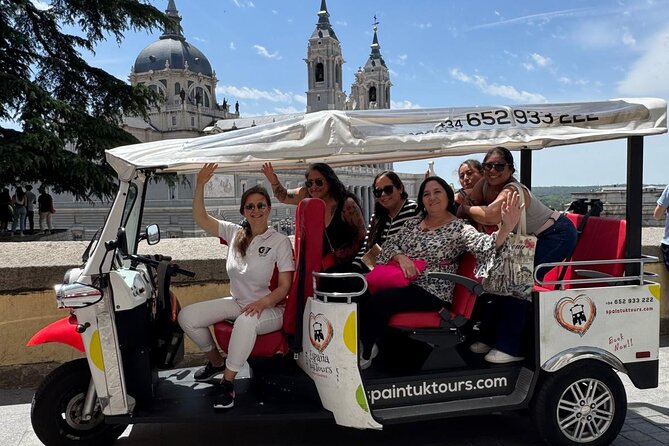
The Royal Palace of Madrid is the grand opening sight. It is the official residence of Spain’s king and has 3,418 rooms across about 135,000 square meters. That makes it the largest royal palace in Western Europe, almost twice the size of Buckingham Palace or Versailles.
Your guide gives you context about the palace rather than taking you through its rooms. The listed admission is free, which in this case means there is no entrance charge included because the tour is primarily a sightseeing and commentary experience. If you want to see the interior, you would need to plan a separate visit.
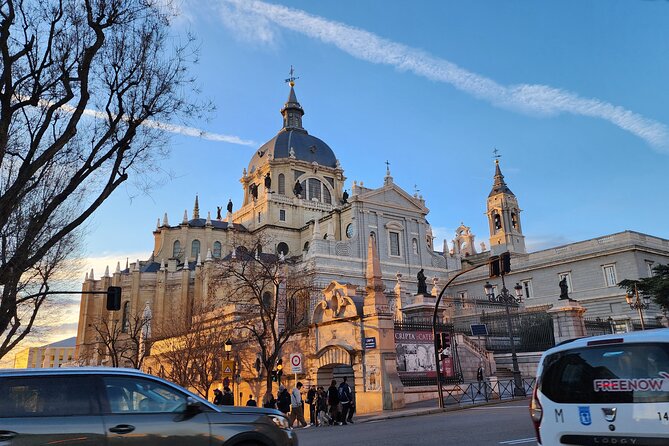
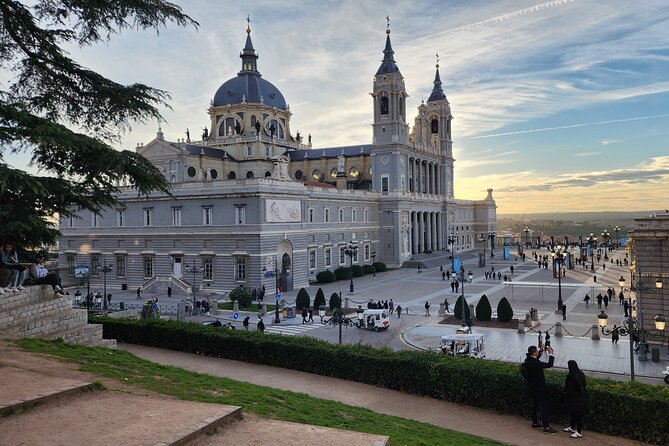
The nearby Almudena Cathedral adds a useful contrast. Its exterior is neoclassical, while the interior is neo-Gothic and the crypt is neo-Romanesque. Construction stretched from the late 19th century into the late 20th century, so this is not a single-period monument.
The cathedral occupies the site of an old mosque and takes its name from the Arabic word al-mudayna, meaning citadel. That small detail helps connect modern Madrid with the city’s earlier layers. Again, the tuk tuk gives you an introduction and a look at the building, rather than a full religious or architectural tour inside.
San Francisco el Grande and the old city gates
The route continues to the Royal Basilica of San Francisco el Grande, a large church in Madrid’s historic center. It belongs to the Franciscan convent of Jesus and Mary and sits by the Plaza de San Francisco, where Calle Bailén and Carrera de San Francisco meet.
This is a good example of why a small vehicle helps. Madrid’s central streets can feel confusing when you are walking between major landmarks, but the guide connects the church to the surrounding neighborhood and its older urban layout.
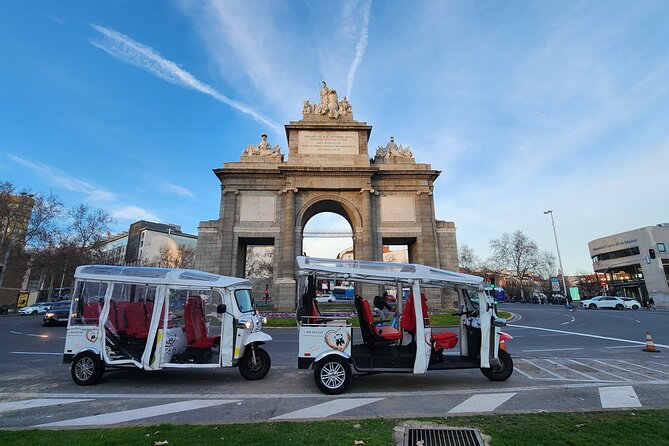
At Puerta de Toledo, you see one of Madrid’s former city entrances. The current gate dates from the first third of the 19th century and was designed by Antonio Aguado. It was built as a triumphal arch honoring King Ferdinand VII and marking Spanish independence after the French occupation.
The gate now sits in the middle of a roundabout, so this is a photo and explanation stop rather than a quiet place to linger. Still, it gives you a quick lesson in how Madrid expanded beyond its old walls and how political events shaped the city’s monuments.
The art district, Atocha, and the Prado
The route then reaches Plaza de Cánovas del Castillo and the Neptune Fountain. The neoclassical fountain was proposed in 1777, built between 1782 and 1786, and moved to its current square in 1898.
Neptune is one of the famous fountains along Madrid’s grand central axis. You will also see the setting around Atocha Station, the country’s busiest railway station by passenger traffic. It began as a simple halt in 1851 and later became a major railway complex, including the station opened in 1892.
The tour passes the Reina Sofía Museum, housed in a former 18th-century general hospital. The building was designed first by José de Hermosilla and later continued by Francesco Sabatini. The museum opened in 1992, with a newer Jean Nouvel building added in 2005.
If modern art interests you, make a note to return. The most famous work associated with the museum is Pablo Picasso’s Guernica, which moved there from the Casón del Buen Retiro in 1992. The tuk tuk cannot give you the time needed for a serious museum visit, but it shows you how the city’s art institutions fit together.
More Private Tuk Tuk Tours in Spain
- Madrid Express Tour with Local Guide in Eco Tuk Tuk Private
★ 5.0 · 413 reviews - Madrid: City Tours – 6 seats private ecological tuk tuk
★ 4.6 · 230 reviews - Madrid Expert Tour with Local Guide in Eco Tuk Tuk Private
★ 5.0 · 220 reviews - Madrid Expert Plus Tour with Local Guide in Eco Tuk Tuk Private
★ 5.0 · 162 reviews
Retiro’s royal remains and museum buildings
The old monastery of San Jerónimo el Real, usually called Los Jerónimos, was once one of Madrid’s most important monasteries. It stood beside the Royal Room, which later grew into the Buen Retiro Palace under Philip IV.
Nearby, the Casón del Buen Retiro is one of only two surviving buildings from that palace complex. Built by Alonso Carbonel in 1637, it began as a ballroom for the court of Philip IV. It later formed part of the Prado Museum system and once held 19th-century paintings as well as Picasso’s Guernica.
The Salón de Reinos is another surviving part of the old Buen Retiro Palace. Built between 1630 and 1635, it was the palace’s grand representative room and held many paintings now found in the Prado. Its name comes from the coats of arms representing the 24 kingdoms of the Spanish monarchy under Philip IV.
These stops are especially useful for showing that Madrid’s museum district is not just a line of impressive buildings. It is also the remains of a royal complex that once filled much of the area. You will not have time to study every facade, but the guide can give you a clear sense of how the pieces relate.
The Prado and Spain’s grand cultural axis
The Prado Museum is the biggest art name on this route. Its collections are especially strong in Spanish and European painting from the 15th through the 18th centuries, along with Spanish works from the 19th century.
Velázquez, El Greco, Goya, Titian, Rubens, and Bosch are among the artists most closely associated with the museum. Goya has the largest representation there, while the Prado’s collections of Velázquez, El Greco, and Bosch are among the finest anywhere.
The tuk tuk gives you a valuable exterior orientation, especially if you are unsure which museum deserves your limited time. I would not treat a drive past the Prado as a museum visit. If you care about art, reserve a separate block for the interior and use the tour to understand where it sits in relation to the Reina Sofía and the rest of central Madrid.
The Royal Spanish Academy is another distinctive stop. Founded in 1713 on the initiative of Juan Manuel Fernández Pacheco, it helps set standards for the Spanish language and works with 23 other language academies through the Association of Spanish Language Academies.
That is a thoughtful inclusion. The building is not as instantly famous as the Prado, but the institution offers a glimpse of Spain’s cultural and linguistic influence far beyond Madrid.
Puerta de Alcalá, Las Ventas, and Salamanca
Puerta de Alcalá is one of Madrid’s five former royal gates. It now occupies the center of Plaza de la Independencia, close to the Retiro entrances and the meeting of several major streets.
The gate makes a strong quick stop because it is easy to recognize and easy to place on your mental map. You are looking at a former entrance to the city, not simply a decorative arch in a traffic circle.
Las Ventas takes the route farther east. It is Madrid’s largest bullring, with space for 23,798 spectators. Its ring measures 61.5 meters across, making it one of the largest in the world by diameter.
The tour does not include a bullfight or an interior visit, but the exterior gives you a chance to decide if you want to return. Bullfighting remains an important and contested part of Spanish culture, so a short explanation from the guide can be more useful than a quick photograph alone.
The Salamanca district brings a different side of Madrid. Built in part during the 19th century under José de Salamanca y Mayol, it is now known for luxury shopping and streets such as Serrano, Claudio Coello, and Ortega y Gasset.
If you want designer shops, polished streets, and a change from the older central quarter, this part of the route helps you place Salamanca on the map. It also shows how sharply Madrid’s neighborhoods can change within a short distance.
The National Library, Bank of Spain, and Gran Vía
The National Library of Spain is responsible for collecting and preserving the country’s bibliographic heritage. Its holdings include books, magazines, maps, engravings, drawings, music, and pamphlets, with around 30 million publications produced in Spain since the early 18th century.
You will see the institution from outside and hear about its role. It is a useful stop for anyone interested in Spanish literature, language, or national culture, even if it receives less attention than the art museums.
The Bank of Spain comes next. Founded in Madrid in 1782 by Carlos III, its main headquarters was built between 1884 and 1891 at the junction of Calle Alcalá and Paseo del Prado, facing Plaza de Cibeles.
This is another place where a guide adds value. A grand civic building can look like just another handsome facade when you pass it alone. A short explanation identifies its role as Spain’s central bank and places it within the city’s political and financial center.
Gran Vía provides the lively finish. The avenue runs from Calle de Alcalá to Plaza de España and is known for shops, theaters, cinemas, and musical productions. The section between Plaza de Callao and Plaza de España is often compared with Broadway because of its theater activity.
The route spends about 10 minutes at Gran Vía, which is enough for a quick look and orientation. You may want to return after dark or walk it slowly later, especially if you are interested in shopping, theaters, or Madrid’s early 20th-century architecture.
What the guide adds to the ride
The guide is the heart of this experience. The vehicle gets you from place to place, but the commentary turns a string of buildings into a connected story.
Simon is praised for guiding guests through Madrid efficiently and for helping them finish away from their hotel so they could continue sightseeing. Sebastian is described as warm, clear, and particularly good at pointing out places that are easy to miss. He has also used Italian for guests who needed it, but English is the stated tour language.
Pedro is remembered for making the city feel more historical for a family group. Pablo is noted for being accommodating and informative. Charlie’s style combines historical facts, local anecdotes, humor, and lesser-known corners. These details suggest that the tone may vary slightly by driver, but the service is designed to be personal rather than scripted and distant.
I would ask questions as you go. Tell the guide if you care most about museums, royal Madrid, architecture, shopping, or food neighborhoods. The tour is short, so your questions can help you get more from the limited time.
Who should book this private Madrid tour?
I would recommend it to first-time visitors who want a quick overview before choosing where to spend the rest of their stay. It also suits families, couples, and small groups who prefer a private ride to a large coach.
It can work well for anyone with limited mobility, since you can see many landmarks without walking between them, although the supplied information only confirms that most people can participate and that service animals are allowed. You should check any specific mobility needs before booking.
This is less suitable if your main aim is entering museums, touring the Royal Palace, or spending long periods at each monument. It is also less attractive for solo visitors because the private group price is not shared across several people.
The price includes all fees and taxes. Lunch and dinner are not included, so plan your meal separately. You receive confirmation at booking, and free cancellation is available up to 24 hours before the start time. Changes or cancellations inside that 24-hour window are not accepted for a refund.
My call: a smart first look at Madrid
Book this tour if you want a private, efficient introduction to Madrid and can share the cost with three other people. Its best features are the broad route, the small-group format, and guides who add personal stories and practical neighborhood advice.
Choose an early start if possible, since traffic can eat into a 90-minute tour. Then use the ride as a planning tool: return to the Prado, Reina Sofía, Royal Palace, Retiro, or Gran Vía when you have the time to explore properly.
I would not book it as your only cultural experience in Madrid. I would book it to get oriented quickly, hear the city explained by a local guide, and decide what deserves a slower second look.
FAQ
How long is the Madrid tuk tuk tour?
The tour lasts approximately 1 hour and 30 minutes.
How many people can join the private tour?
The private tuk tuk accommodates a group of up to four people.
What language is the tour offered in?
The tour is offered in English. One guide, Sebastian, has also used Italian to help guests understand the city, but Italian is not listed as the standard tour language.
Where does the tour begin and end?
The tour begins at Pl. de la Lealtad, 1, Retiro, 28014 Madrid, Spain, and ends back at the same meeting point.
Are meals included?
No. Lunch and dinner are not included. All fees and taxes are included.
Can I cancel for a full refund?
Yes. You can cancel at least 24 hours before the experience start time for a full refund. Cancellations or changes made less than 24 hours before the start time are not accepted for a refund.
More History Rides in Madrid
- Tour of Historic and Modern Madrid with a guide in a yellow tuk tuk
★ 5.0 · 71 reviews - Madrid: Tuk-tuk tour of the historic center and highlights
★ 4.7 · 20 reviews - Madrid: Tuk Tuk Tour of the Historic Heart and Gran Vía. 1h 15min
★ 4.7 · 9 reviews - Explore Lisbon by Tuk Tuk: History and Viewpoints
★ 5.0 · 840 reviews
Just added around Madrid
- Tuk-tuk tour of downtown Madrid★ 5.0 · 2 reviews
- Eco Friendly Tuk Tuk Experience with the Local in Madrid★ 5.0 · 4 reviews
- Tour Madrid: Royals, Plazas & Secrets 3H★ 4.5 · 14 reviews
- Discover Madrid in a Fun & Eco-Friendly Tuk-Tuk – Private Tour★ 4.0 · 4 reviews
- Tour en tuk-tuk electrico por MADRID MODERNO★ 4.5 · 60 reviews
- Tuk Tuk Tour of the Best of Madrid (booking only)★ 5.0 · 2 reviews
- Madrid in Tuk Tuk with Local Guide Included★ 5.0 · 5 reviews
- Tuk Tuk Zero Private Tour: The Best of Madrid in 2hrs. 15min.★ 3.0 · 2 reviews
Private Tuk Tuk Tours, compared.
True 4Hour Private Tuk Tuk Tour: Discover Lisbon with a Local!
Read our review →
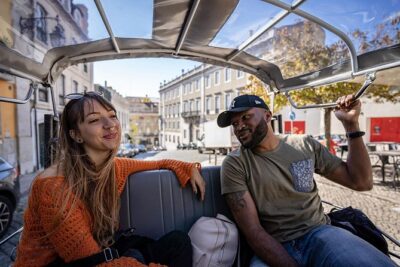
Private Lisbon Sightseeing Tuk-Tuk Tour: Alfama, Belém & More
Read our review →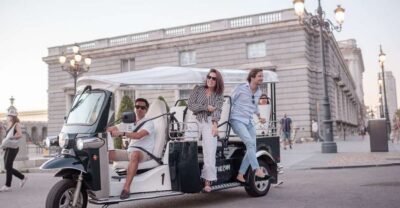
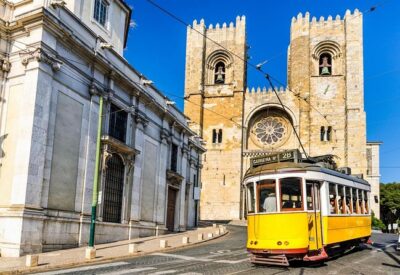
Lisbon Highlights: Private Tuk Tuk Tour Adventure Sightseeing
Read our review →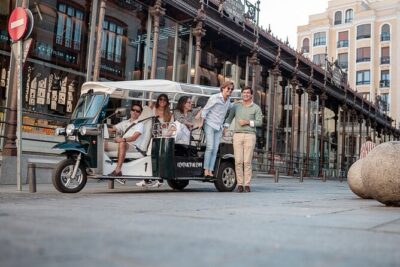
Madrid Welcome Tour with Local Guide in Eco Tuk Tuk Private
Read our review →
Private Tuk-Tuk City Tour with All Entry Fees
Read our review →Where else this ride shows up