
REVIEW · TEMPLE TUK TUK TOURS
Battambang family tuktuk tour BambooTrain/Wat Banan/Bat cave
Battambang’s best day out is a slow ride through the countryside, with the Bamboo Train and a sunset bat flight providing the big moments. Between them, you’ll pass farms, fishing villages, suspension bridges, old Khmer houses, and two mountain sites with very different stories.
I like the way this trip mixes ordinary local life with major sights. I also like guide Pao’s personal approach: he explains Cambodian culture, daily life, and the Khmer Rouge period, then takes time for questions. The drawback is that the $8 headline price does not cover several important costs, and the day is long, active, and not suited to anyone with limited mobility.
Key points to know
- The Bamboo Train is a real countryside ride: You sit on a small bamboo platform as it rolls along a single track through farms and rice fields.
- Pao is the guide to request: He speaks English and is especially praised for explaining local history, culture, and everyday life.
- Wat Banan rewards the climb: Its five towers sit above the countryside, but the mountain setting means steps and uneven ground.
- Phnom Sampeau is both beautiful and painful: The temple and views share the mountain with killing caves linked to the Khmer Rouge period.
- The bat flight is the day’s grand finish: At dusk, millions of bats stream from the cave in a remarkable natural display.
- Budget extra cash: Bamboo Train, temple, cave, and mountain transport fees are separate from the $8 tour price.
Why this Battambang day trip works
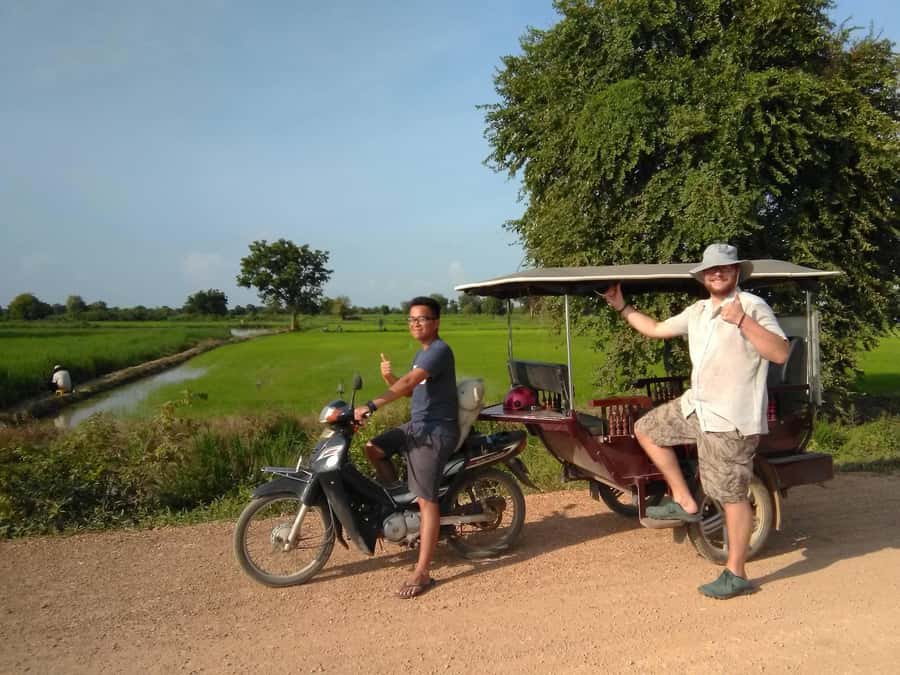
I see this as a full introduction to the area south of Battambang rather than a simple list of monuments. The tuk-tuk keeps the pace close to the ground. You see crops growing beside the road, small villages, river crossings, and people going about daily work.
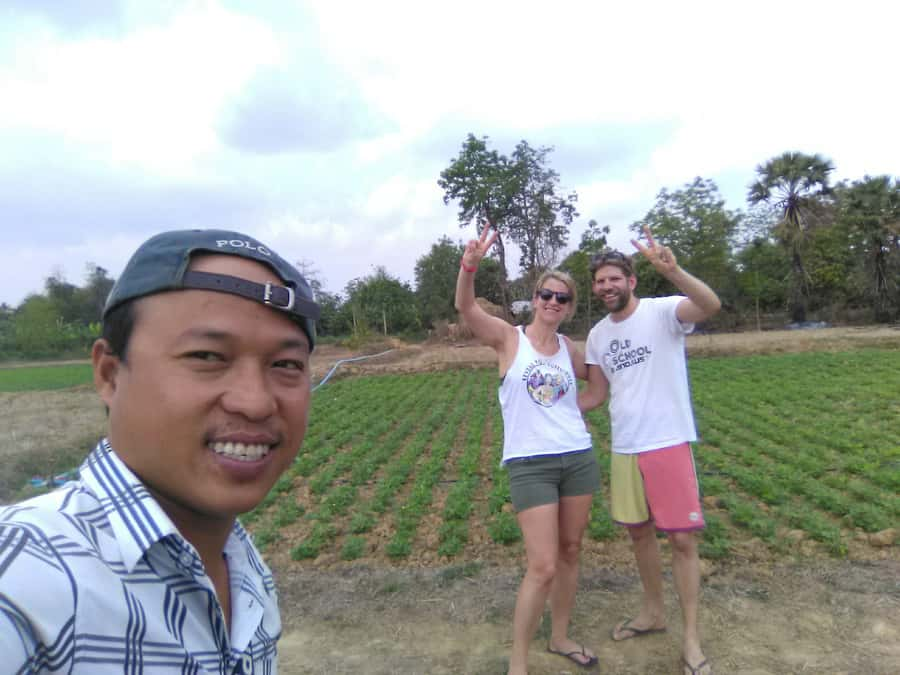
That matters because Battambang is not only about temples. It is a farming province, and the early part of the day gives you a useful look at that side of Cambodia. You may taste local fruit and vegetables from a farmer, see long beans, corn, chili, and peanuts in the fields, and pass fish farms and a fishing village.
The price is attractive at $8 per person, especially with hotel pickup, drop-off, a live guide, tuk-tuk transport, bottled water, fruit tasting, and countryside visits included. But you need to read that price as the starting cost. The Bamboo Train is listed at $5 per adult, Wat Banan at $2, the killing cave and bat cave at $1, and the jeep or scooter up Phnom Sampeau at $5 per adult.
If you use all of those paid options, you are looking at about $21 per adult before lunch. That is still fair for a long private or small-group-style day with transport and a guide, but it is not an $8 all-inclusive outing. Bring cash and ask Pao or the operator at the start which fees you will need to pay.
More Temple Tuk Tuk Tours in Cambodia
- Morning Tuk tuk: City, Handicrafts, Killing field, Temples
★ 4.9 · 13 reviews - Siem Reap: Angkor Wat Private Tuk-Tuk Tour
★ 4.9 · 2,222 reviews - Angkor Wat Private Tuk-Tuk Tour (sunrise Option) & more
★ 5.0 · 439 reviews
A gentle start along the Sanker River
Pickup is at 9:00 AM from your hotel or restaurant in Battambang. You should wait in the lobby at least 15 minutes early. The day begins with a slow tuk-tuk route beside the Sanker River, a pleasant change from riding straight to a major sight.
This part is about seeing the countryside at close range. The route passes crops, farms, fish ponds, a fishing village, and suspension bridges. Long beans, corn, chili, and peanuts are among the produce you may see growing nearby.
The river section also gives Pao room to explain local life. His strongest quality, based on the way the tour is conducted, is that he does not treat the area as scenery only. You can ask about food, work, Cambodian customs, and the country’s past.
One practical note: the details include a river route, but you should not assume that a separate boat ride is part of the day. A boat was not arranged on one outing, so confirm this before setting off if a water trip matters to you. The advertised core experience is the tuk-tuk ride along the river and countryside.
Riding the Bamboo Train through farm country
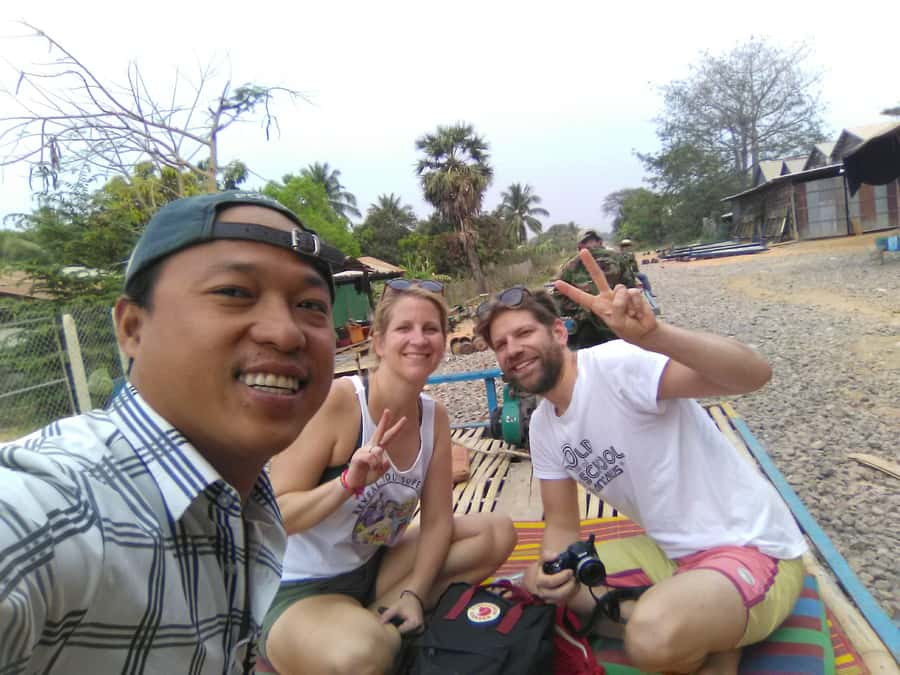
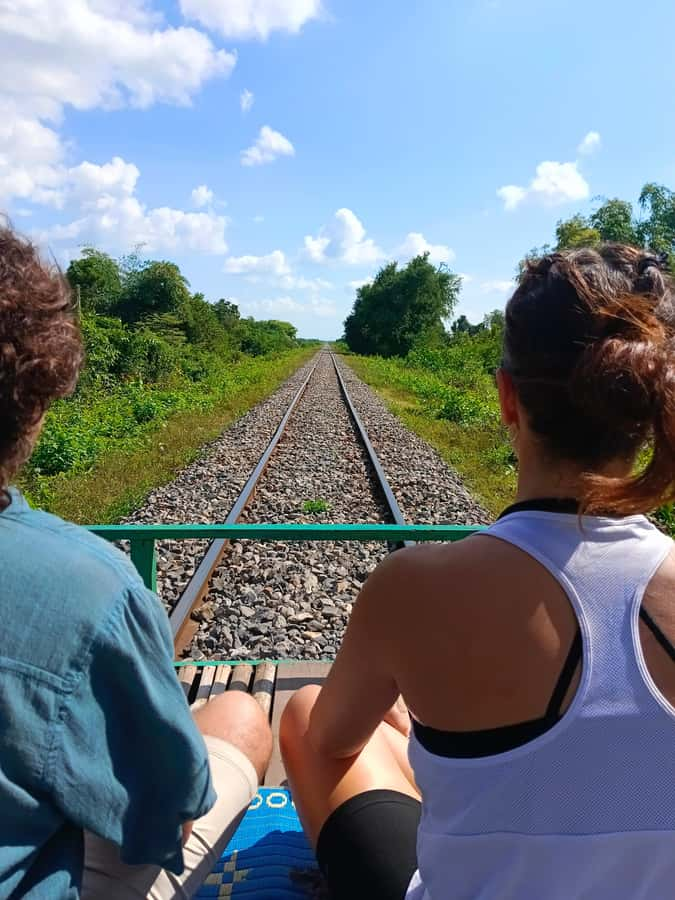
The Bamboo Train is the most unusual stop, and it is easy to see why it remains popular. The vehicle is a simple bamboo platform, about 2.5 by 4 meters, fitted with wheels and powered along the railway line. It feels more like a clever local machine than a polished tourist attraction.
The ride lasts about an hour. You roll past paddy fields, farms, countryside, and a lotus farm. This is not a fast thrill ride. It is a relaxed way to watch the land pass by, with the small engine and open sides giving you a clear view in every direction.
The single track creates the famous bit of railway etiquette. Trains use the same line in both directions, so if another platform approaches, the drivers decide which one has the lighter load and remove it from the track. The bamboo platform can then be lifted aside, allowing the other train to pass.
That simple arrangement is part of the fun, but it also tells you what to expect. This is a basic ride, not a luxury railway excursion. You sit on a hard, open platform, and you should keep your camera secure. The experience works best if you enjoy unusual transport and rural views rather than expecting a long history lesson or a high-speed adventure.
The $5 adult charge is separate. Ask whether children are charged the same way before you go, since the supplied price only specifies adults.
Wa Kor Village and the old Khmer house tradition
After the Bamboo Train, the route continues south toward Wa Kor Village, described as a home for traditional Khmer houses. This stop adds cultural context to the farm scenery.
You are not simply moving from one ticketed attraction to the next. The route connects old homes, village roads, crops, and bridges into a picture of how people have lived in the Battambang area. You may also pass the Swing Bridge on the river, another small but memorable feature of the road.
This section is less dramatic than Wat Banan or Phnom Sampeau. That is precisely why I value it. You get time to notice the shape of local houses and the way villages sit among fields, rather than spending the entire day inside formal sites.
The tour description also includes fruit bats and a bat tree along the route. These are smaller wildlife stops, but they build anticipation for the much larger bat display later in the afternoon.
More Temple Tuk Tuk Tours in Battambang:
- Bangkok by Night: Temples, Markets and Food Tuk-Tuk Tour
★ 5.0 · 3,752 reviews - Bangkok: Markets, Temples and Food Night Tour by Tuk Tuk
★ 4.9 · 2,371 reviews - Bangkok: Tuk Tuk Adventure Chinatown Michelin Food & Temples
★ 4.3 · 725 reviews - Bangkok: Evening Tour with Wat Arun, Wat Pho & Tuk Tuk Ride
★ 4.6 · 701 reviews
Wat Banan and its five stone towers
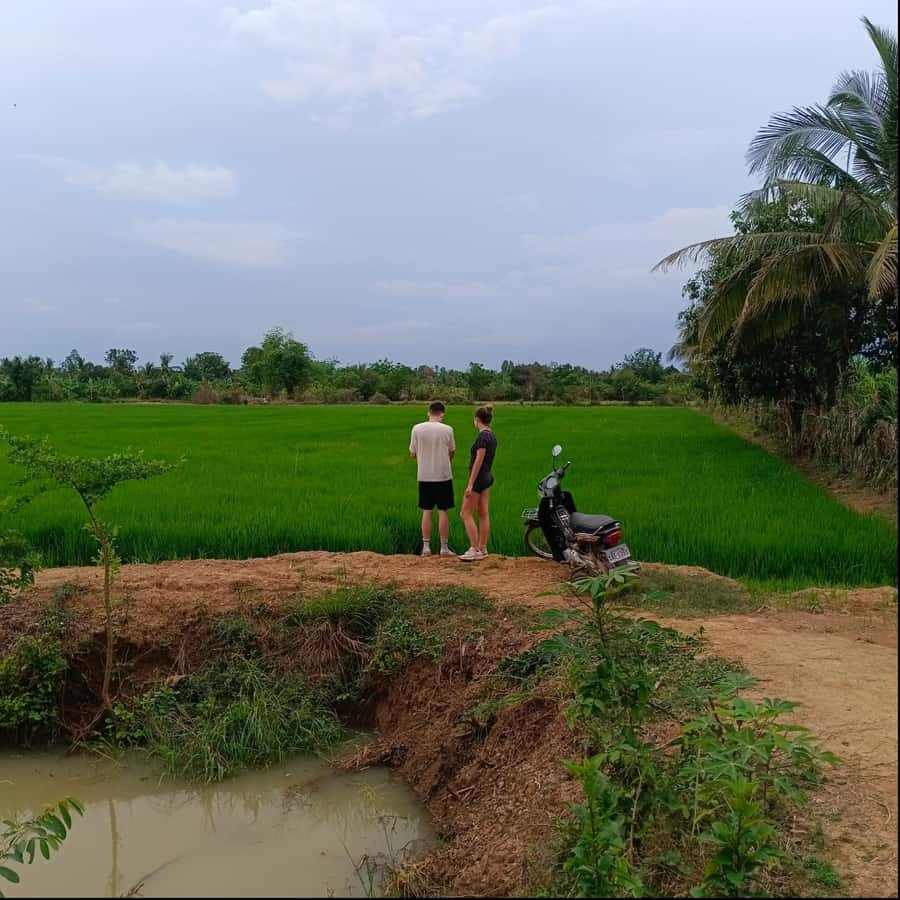
Wat Banan sits on a hill, with five towers and wide views over the surrounding countryside. The temple is the main architectural stop and gives the day a strong visual centerpiece.
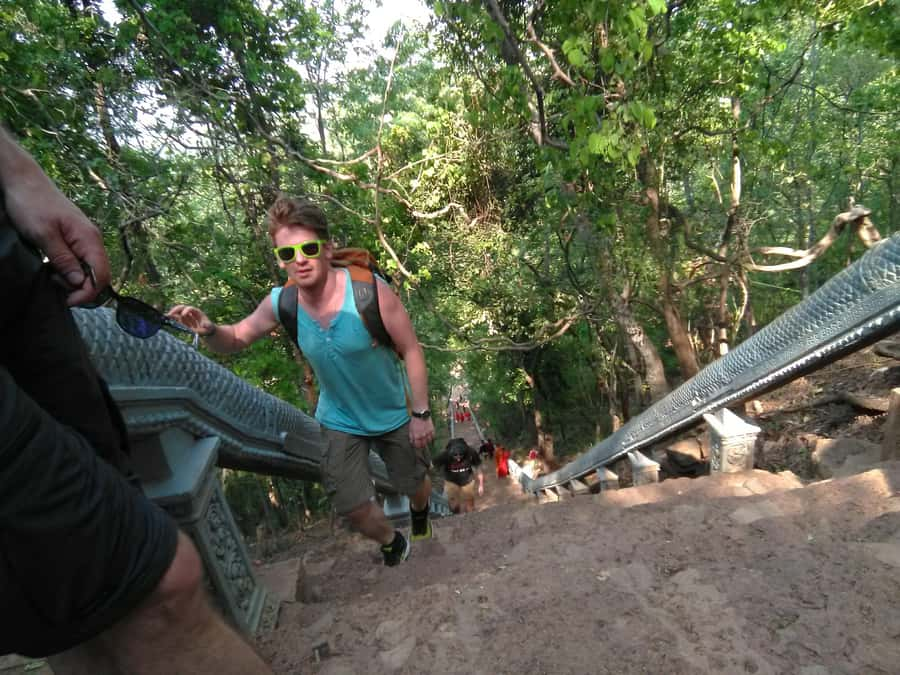
Reaching the temple involves a climb. The trip includes hiking the mountain, so comfortable shoes are essential. The exact effort will depend on your pace, but this is not a flat sightseeing stop. Uneven surfaces, heat, and the number of steps can make it tiring, especially after the Bamboo Train and village visits.
The reward is the setting. From Wat Banan, you look across fields and rural Cambodia rather than a dense city center. The five-tower design gives the temple a distinct profile, while the open surroundings make the site feel spacious.
The entrance fee is $2 per person. Keep small bills handy, since several separate payments are likely during the day. If you prefer a gentle schedule, tell Pao early. The itinerary packs many stops into one day, and you will get more from Wat Banan if you do not rush the climb.
Phnom Sampeau, the killing caves, and a difficult history
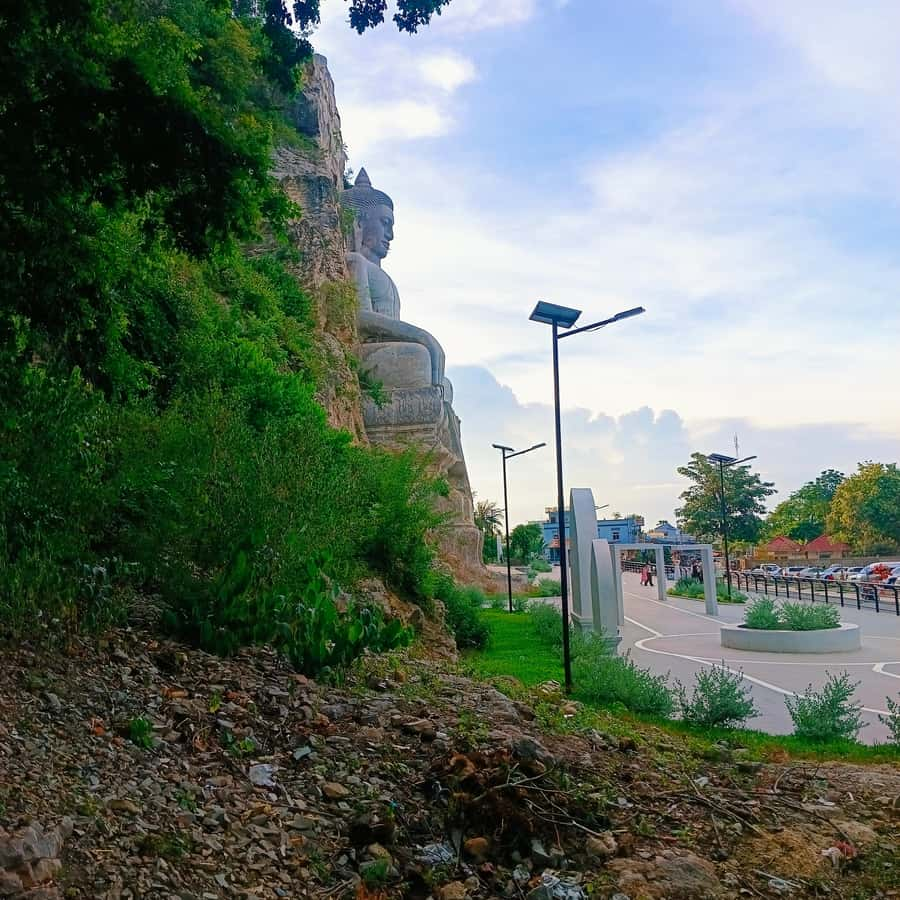
The final major area is Phnom Sampeau, a mountain about 140 meters high. The full route includes roughly 800 steps to the top, but the tour avoids making you climb the entire way by using a motorbike or jeep for the first section.
That transport costs $5 per adult. It is a useful option because the mountain comes late in a long day, when your legs may already be tired. Even with the ride, you should expect walking around the temple, shrines, viewpoints, and cave area.
Phnom Sampeau carries heavy historical weight. The killing caves were used during the Khmer Rouge period, and the visit can be intense. This is not a light sightseeing stop, and Pao’s explanations are especially important here. He can help place the shrines and caves within Cambodia’s recent past rather than leaving you to guess what you are seeing.
You also get a broad view over Battambang from the mountain. The contrast is striking: fields and villages spread below, while the caves remind you of one of the country’s darkest periods. Give yourself time to be quiet. You do not need to hurry through this part simply to reach the bats.
The combined killing cave and bat cave fee is listed as $1 per adult. Dress respectfully, cover your shoulders, and note that sleeveless shirts are not allowed. Comfortable shoes are again a must.
The bat flight at dusk
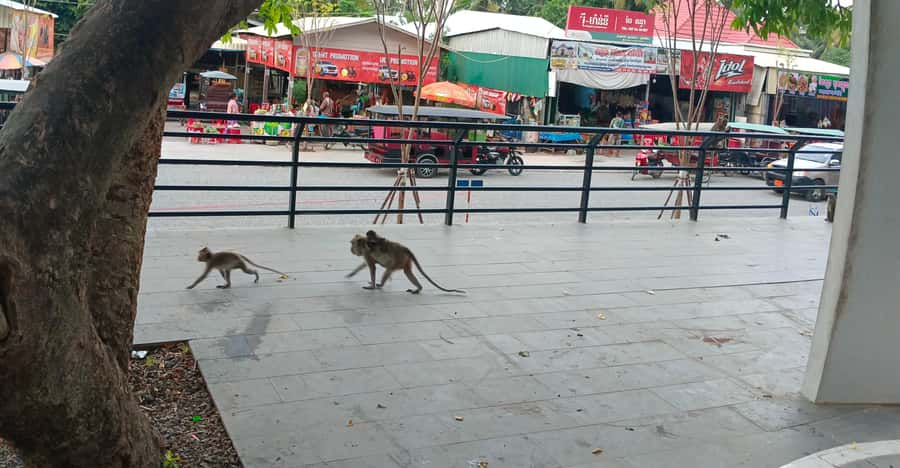
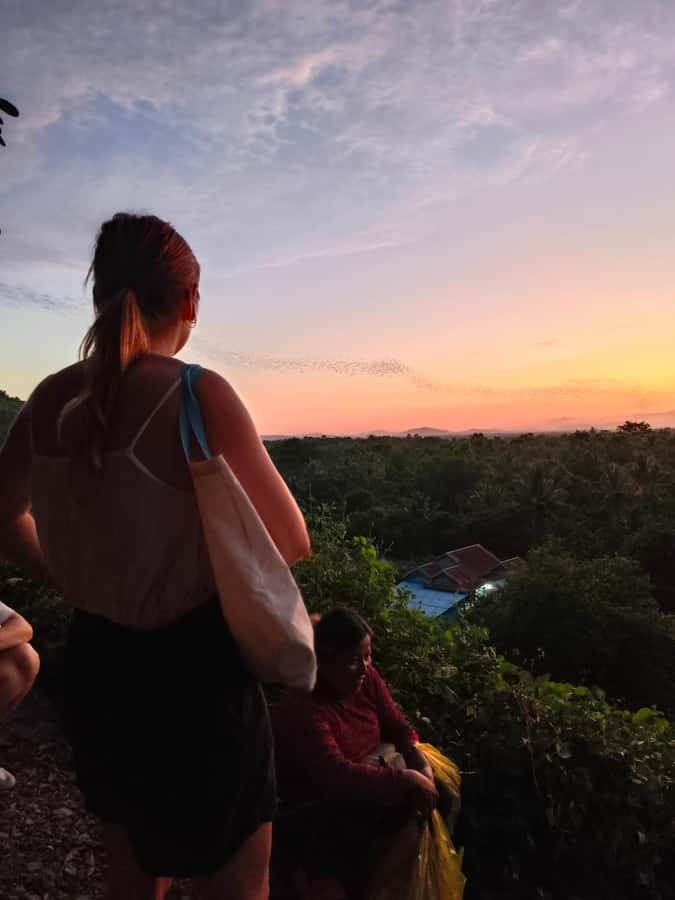
The day ends with a walk down the mountain steps and a visit to the Bat Cave. At dusk, millions of bats fly out from the cave in a long stream.
This is the tour’s most memorable natural event. You are not watching a staged performance or visiting a display indoors. You wait outside the cave and watch the bats pour into the evening sky. The timing matters, so the day is arranged to reach Phnom Sampeau before sunset.
The exact viewing conditions can depend on the timing of dusk, but the attraction is clear: a huge number of bats leaving the mountain in one continuous movement. It is a simple ending after a day filled with roads, temples, farms, and difficult history.
The tour finishes back in Battambang at about 7:30 PM. That makes hotel drop-off convenient, but it also confirms that this is a full-day commitment. Do not schedule a bus, dinner reservation, or other fixed plan too close to the return time.
What Pao adds to the day
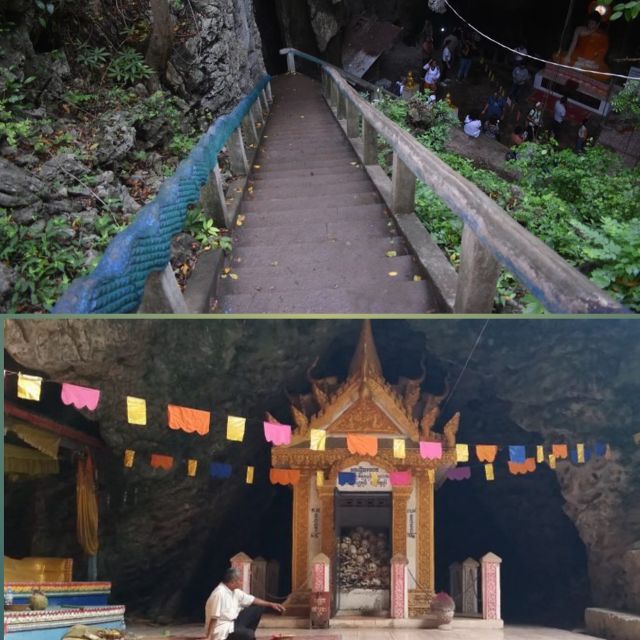
The guide can make or break a countryside tour, and Pao appears to be the main reason this one works so well. He speaks English and focuses on more than dates and names. You can ask him about Cambodian daily life, food, culture, local work, and the history of the places you visit.
His style is particularly useful at the killing caves, where facts without context can feel abrupt. It is also valuable in the countryside, where a field of crops or a fishing village may otherwise pass by as a pretty view.
English ability can vary in everyday conversation, so do not expect a formal academic lecture. The useful part is the personal exchange. Pao takes time to explain the next stop and answer questions, even if you need to speak slowly or ask him to repeat a point.
If you book, ask for Pao by name. The experience is built around a live English-speaking guide, and the strongest praise is directed at his care, local knowledge, and warmth.
The real cost, pace, and practical details
The base price is $8 per person. Included are hotel pickup and drop-off in the Battambang area, tuk-tuk transport, an English-speaking guide, cold bottled water, local fruit and vegetable tasting, countryside sightseeing, and the mountain portion of the trip.
The following costs are not included:
- Bamboo Train: $5 per adult
- Wat Banan: $2 per person
- Killing Cave and Bat Cave: $1 per adult
- Jeep or scooter up Phnom Sampeau: $5 per adult
- Lunch
Using every listed paid option brings the adult total to roughly $21 before food. That remains good value for a day lasting from 9:00 AM to around 7:30 PM, but you should compare the total rather than the advertised base rate alone.
Bring a camera, cash, and comfortable shoes. Bottled water is supplied, but the combination of heat, walking, and a long tuk-tuk day makes sensible clothing important. Sleeveless shirts are not allowed, and respectful clothing is especially appropriate at Wat Banan, Phnom Sampeau, and the killing caves.
The tour is not suitable for wheelchair users, people with mobility impairments, or anyone over 80 according to the supplied conditions. You should also think carefully about the 800-step mountain route, even though a motorbike or jeep can shorten the climb.
Who should book this experience
I would choose this tour if you want to see several sides of Battambang in one day. It suits families with older children, couples, solo visitors, and anyone who prefers local roads and conversation to a string of indoor attractions.
It is also a good choice if you want a guide who can connect Cambodia’s present-day villages with the country’s recent past. The mix is unusually broad: farming, transport, traditional houses, temple architecture, Khmer Rouge history, mountain views, and wildlife.
You may want a shorter or more focused outing if you dislike long days, tuk-tuk travel, heat, or stairs. The tour moves at a good pace, but it is busy. One person described it as an action-packed day, which is a fair warning. The killing caves can also be emotionally hard, so consider that before booking.
Should you book the Battambang Bamboo Train and bat cave tour?
Book it if you want an affordable, full-day look at Battambang beyond the city center, and especially if you can request Pao. The Bamboo Train is fun in its own simple way, Wat Banan gives you strong views and temple architecture, and Phnom Sampeau combines Cambodia’s painful history with one of the country’s most memorable natural sights.
Go in with the right budget and expectations. Plan for about $21 per adult if you take all listed paid options, bring lunch money, wear covered clothing and good shoes, and leave your evening free until 7:30 PM.
I would not choose it for a relaxed half-day or for anyone who struggles with steps and uneven ground. For most active visitors, though, the mix of real countryside, thoughtful guiding, and the bat flight makes this one of Battambang’s better-value day trips.
FAQ
What time does the tour start and finish?
Pickup begins at 9:00 AM, and the tour ends back in Battambang at about 7:30 PM.
Where can I be picked up?
Your guide can collect you from any hotel or restaurant in the Battambang area. Wait in the lobby at least 15 minutes before the scheduled start.
Is the Bamboo Train included in the $8 price?
No. The Bamboo Train costs $5 per adult and is paid separately.
What other costs should I expect?
Wat Banan costs $2, the killing cave and bat cave cost $1 per adult, and the jeep or scooter up Phnom Sampeau costs $5 per adult. Lunch is also not included.
Who guides the tour?
The English-speaking guide is Pao. You can ask him about Cambodian history, culture, local life, and the sites visited during the day.
What should I bring and wear?
Bring a camera, cash, and comfortable shoes. Sleeveless shirts are not allowed, so wear clothing that covers your shoulders.
Just added around Battambang
- Private Half-Day Tuk Tuk Tour in Battambang★ 5.0 · 2 reviews
- half day morning tour by Tuk-Tuk★ 5.0 · 20 reviews
- Morning Tuk Tuk Food Tour: Taste Iconic Dishes of Battambang★ 5.0 · 2 reviews
- Tuk Tuk Tour (Full-Day)★ 5.0 · 7 reviews
- Full-Day Battambang with a local Tuk Tuk Tours★ 5.0 · 2 reviews
- Full/Half Day Tuk TuK: Handicrafts Bambootrain Killing&Bat Caves★ 5.0 · 14 reviews
- Private Full Day Tuk Tuk Tour in Battambang★ 5.0 · 12 reviews
- Morning Tuk tuk: City, Handicrafts, Killing field, Temples★ 4.9 · 13 reviews
Temple Tuk Tuk Tours, compared.
Bangkok by Night: Temples, Markets and Food Tuk-Tuk Tour
Read our review →
Markets, Temples and Food Night Tour by Tuk Tuk
Read our review →
Tuk Tuk Adventure Chinatown Michelin Food & Temples
Read our review →
Evening Tour with Wat Arun, Wat Pho & Tuk Tuk Ride
Read our review →
Chiang Mai Temples and Market Tuk-Tuk Evening Night Tour
Read our review →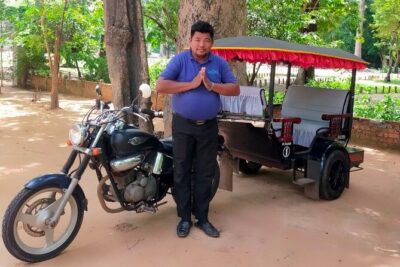
Angkor Wat Private Tour by Tuk-Tuk with English Speaking Driver
Read our review →Where else this ride shows up